
Short answer: these two solve different problems, and a young puppy usually needs the sweater first. The JECIKELON fleece sweater is a pull-on knit that goes over the head in one motion, weighs next to nothing, and handles the 35 to 45 degree morning walk that starts with a shiver at the end of the driveway. A quilted puppy coat is the better tool once it drops below freezing, the wind picks up, or the walk runs longer than a loop around the block.
I have had the JECIKELON sweater on Clover, my seven month old mini goldendoodle, for about five weeks. I have not owned a puppy coat. I have read the listings, squeezed them in the pet store aisle, and watched my sister-in-law wrestle one onto her dog on Thanksgiving. So I will be plain about which parts of this I know from daily use and which parts I know from looking hard.
| JECIKELON Fleece Sweater | Quilted Puppy Coat | |
|---|---|---|
| Warmth on a dry walk | Fleece knit traps body heat; enough for a puppy who shivers in the 40s | Quilted shell with a lining holds heat and blocks wind below freezing |
| Coverage | Neck to the base of the tail; belly and back legs mostly open | Longer body, higher belly panel, often a hood |
| Getting it on | Pull-on over the head, one motion, no straps to line up | Belly closure, so you line up two flaps while the puppy stands still |
| Adjusting for growth | The knit gives a little stretch; past that you buy the next size | Hook-and-loop belly strap adjusts an inch or two either way |
| Machine washing | Machine wash, air dries fast, came out the same shape | Machine washable, but the quilting and lining hold water longer |
| Weight on the dog | 1.76 ounces, she moves like it is not there | More structure and bulk; some puppies walk stiffly the first time |
| Wet weather | Soaks through in a drizzle, it is not a rain layer | Smooth shell sheds light rain and wet snow |
| All day indoors | Soft enough to leave on for a nap on the couch | A walk layer, most people take it off at the door |
| Mud, burrs, road salt | Knit picks things up and needs a wash | Wipes clean with a damp cloth |
| Best for | The puppy who shivers on short neighborhood walks | Longer walks in real winter weather |
Why I Compared These Two At All
The first genuinely cold morning here outside Columbus came on October 3. Clover and I got to the end of the driveway, she did her business, and then she sat down and shivered hard enough that I could feel it through the leash. Not a limp, not a paw she was favoring, just cold. We went back inside and I ordered a sweater that night. It arrived in a few days and we have used it every cold morning since.
My first attempt was not a product at all. I wrapped her in a bath towel, carried her to the door, and set her down on the mat, which worked for about ninety seconds before the towel slid off when she walked. Dan suggested a human hoodie with the sleeves knotted, which we did not try, because she is a determined chewer and I could picture a sleeve coming off in her mouth. That is when I opened the laptop and ordered the sweater: a real piece of clothing, sized to her chest, that stays on while she walks.
What I bought is the JECIKELON fleece sweater in size L: 100 percent polyester fleece, a round neck, pull-on with no straps or buckles, machine washable, and it weighs 1.76 ounces on my kitchen scale. The listing runs six sizes from XX-Small up to X-Large and tells you to measure chest girth and check the size chart rather than guess from weight. I did that, with a cloth tape and a puppy who thought the tape was a toy, and the L is what the chart gave me at 21 pounds.
What sent me looking at coats was my sister-in-law. Her dog is older and they walk a greenway in January, and she has a quilted coat with a hood and a belly closure that she swears by. Watching her dog in it, I could see what a coat does that a sweater cannot. So this is not a review of a coat I tested. It is a clear look at what each layer is for, so you spend once instead of twice.
One sweater, 1.76 ounces, on in a single motion, and the shivering at the end of the driveway stopped.
The layer that goes on in one motion, before the shiver starts
Pull-on fleece in six sizes from XX-Small to X-Large, machine washable, light enough that a puppy forgets she is wearing it. Measure chest girth against the size chart first.
Amazon Check Today's Price on Amazon →Here is the split, in order of what actually matters on a Tuesday morning when you are late for work.
Where JECIKELON Wins
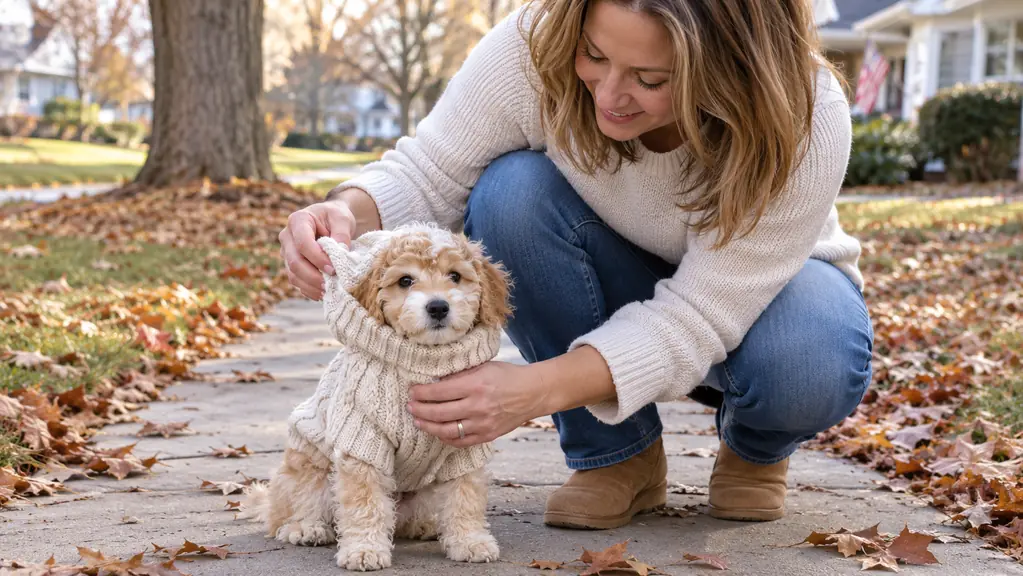
Getting dressed is the whole argument for the JECIKELON sweater. It is a pull-on with a round neck, so it is one motion: gather the neck, ease it over the head, tug it down over the chest, done. No belly flap to line up, no strap to thread under a wiggly puppy who has decided this is a game. From the front door to the sidewalk is about ten seconds, and ten seconds is the difference between a layer that gets used every morning and one that stays folded in the closet.
The routine matters more than it sounds. Ours is: leash off the hook, sweater on, out the door, walk the loop, sweater off at the mat, sweater back on the hook. Because it is one pull and no fasteners, I can do it with a leash in one hand and a coffee in the other, and I have. On the mornings when I was running late for a 7:40 shift and Clover was already at the door doing her impatient dance, the sweater still went on. That is the honest test of any piece of puppy gear for me now: does it survive a rushed Tuesday.
It is also the lighter of the two by a wide margin. At 1.76 ounces it does not change how she walks, and my favorite proof of that is unglamorous: she wears it on the couch for a nap after a cold walk and I forget it is on her. Structured coats are a different experience. They have a shell, a lining, and enough body that a puppy who has never worn clothing will do a stiff-legged walk for the first minute while deciding whether this is allowed.
Washing is the third thing. A polyester fleece knit goes in the machine and comes out looking like it went in, and it air dries fast enough that I can wash it after a muddy walk and have it ready for the evening loop. After five weeks and a wash every week or so, I have no pilling and no stretched out neck. I want to be honest about the limits of that claim: we are five weeks into an Ohio fall, not through a full winter, and the sweater has not been through a February yet.
Where the Quilted Puppy Coat Wins
Real cold is where the coat is simply the right tool. A knit traps warmth close to the body, and that is fine at 40 degrees with no wind. Below freezing, especially on a windy morning, a quilted shell with a lining blocks the air instead of letting it pass through the loops of the fabric. If your walks are 30 or 40 minutes instead of a loop around the block, the coat wins on warmth and it is not close.
I did handle a few before writing this. The pet store near us keeps a rack of quilted coats by the front door, and I spent a slow Saturday morning turning them over and looking at the seams. The ones I liked had a smooth outer shell, a lining you could feel the weight of through your fingers, a strap under the belly, and a leash hole at the back. The ones I did not like had hook-and-loop that had already gone fuzzy from being opened and closed on the rack. That detail told me more than the packaging did.
Coverage is the second thing. The sweater runs from neck to the base of the tail, and the belly and back legs are mostly open, which is normal for a knit. A coat generally runs longer in the body, sits higher on the belly, and many come with a hood. On a wet cold day that coverage means a lot less wet dog to towel off at the door.
The last one surprised me when I looked properly: adjustability. A hook-and-loop belly closure buys you an inch or two in either direction, which matters a lot on a seven month old puppy who is still filling out. A pull-on knit will forgive a little growth via stretch, but when it stops fitting you are buying the next size. If you want one piece of clothing to survive the rest of this winter, a closure that adjusts is a real argument.
Fit and Sizing on a Growing Puppy
Measure chest girth, not weight. That is the single most useful thing I can tell you, and it is what the JECIKELON listing says outright. Stand the puppy on a flat floor, run a cloth tape around the widest part of the chest just behind the front legs, and write the number down. Clover was 21 pounds and in the top of the Small range in a lot of brands, which is why the L surprised me until I actually measured.
The measuring itself took three tries. The first number was wrong because I had the tape over her shoulder blades instead of behind her front legs. The second was wrong because she sat down halfway through and the tape went loose. The third, taken with a treat held at nose height by Dan, was the one I wrote down. If you take one thing from this section, take the treat and the second set of hands.
The honest downside of a pull-on on a puppy is the head. Clover did not love having a sweater pulled over her ears the first two times and backed away from it. What fixed that was two mornings of treats and zero drama: sweater on, treat, walk, sweater off. By the third time she stood still for it. If your puppy is genuinely head shy, a coat with a belly closure avoids the head entirely, and that is a legitimate reason to pick one.
Growth is the other thing to plan around. Clover came home at 6 pounds in April and sits around 21 now, with the breeder expecting 25 to 30 fully grown. Any clothing on a puppy is a this winter purchase and not a forever purchase, so I would rather own one piece that fits well today than a range of sizes I am betting on.
Washing and Daily Wear
I wash the sweater on cold and air dry it, and it has kept its shape. I do not put it in the dryer, mostly because it dries so fast on the back of a chair that there is no reason to. It picks up bits of leaf and the occasional burr on our walks, which is the trade off of knit fabric, and a wash handles it. Road salt is the one thing I watch for and rinse off before it goes in the machine.
One small thing I would change: the knit holds a static charge in dry cold air, and on a couple of mornings it has picked up every loose hair in the laundry room on the way out the door. A pass with a damp hand fixes it. It is a five second annoyance, not a reason to skip the sweater, but it is the kind of thing a listing will never tell you.
None of this makes the coat a bad buy. It makes it a different buy. A smooth quilted shell wipes clean with a damp cloth in about eight seconds, which is why people who walk in slush love them. If you have ever spent a Sunday picking burrs out of fleece, you already know which fabric you want on a muddy trail.
Who Should Buy Which
Start with the JECIKELON fleece sweater if your puppy is small, gets cold fast, and your cold weather walking is short: the morning loop, the evening loop, the driveway. It is the layer that actually gets used because it goes on in one motion and lives in the machine. It is also the right first piece of clothing for a puppy who has never worn anything, because 1.76 ounces is not enough to bother most dogs.
Go straight to a coat if you are walking longer than half an hour in real winter, if your winters go below freezing for weeks at a time, or if your puppy is already wearing a sweater and still shivering at the door. That last one is the clearest signal there is. A sweater is a shiver fixer for mild cold, not a substitute for winter gear, and no fleece knit will shed rain.
If you can only buy one this month and it is October, buy the sweater and see how your puppy does. That is what I did, and it told me something a size chart could not: she tolerates clothing, she warms up quickly, and she is not a dog who wants a hood over her ears. Any health question about how much cold a puppy can handle is one for your own vet, not for me.
Start with the layer your puppy will actually wear
100 percent polyester fleece, pull-on, machine washable, 1.76 ounces, six sizes from XX-Small to X-Large. Measure chest girth and check the chart, then walk out the door in ten seconds.
Amazon Check Today's Price on Amazon →