

Clover came home on a Sunday in April 2026. By Tuesday she had found the corner of the couch, the baseboard behind the TV stand, and one of Dan's running shoes. I had a crate, four boxes of puppy pads, and exactly zero chew toys, which is the kind of planning gap you only make once.
The KONG Puppy was the first toy I bought her, ordered two days after she came home. It is a natural rubber chew made with a softer rubber compound for a growing puppy's teeth, and it is the only thing from those first weeks still in daily rotation now that she is seven months old and hovering around 21 pounds. Everything else from that era has been outgrown, shredded, or quietly retired to the bottom of the toy bin. This is what seven months of daily use actually looks like.
The Quick Verdict
The one toy I would buy again on day one. Soft enough for a nine-week-old mouth, tough enough to survive seven months of daily chewing, and the reason my workday mornings are quiet instead of chaotic.
Amazon Check Today's Price →The first thing I would put in the crate, before anything else
If you are bringing a puppy home this week and you own nothing yet, start here. Small size fits a puppy in the 6 to 20 pound range, and it is the only chew I have not had to replace.
Amazon Check Today's Price on Amazon →How I've Used It
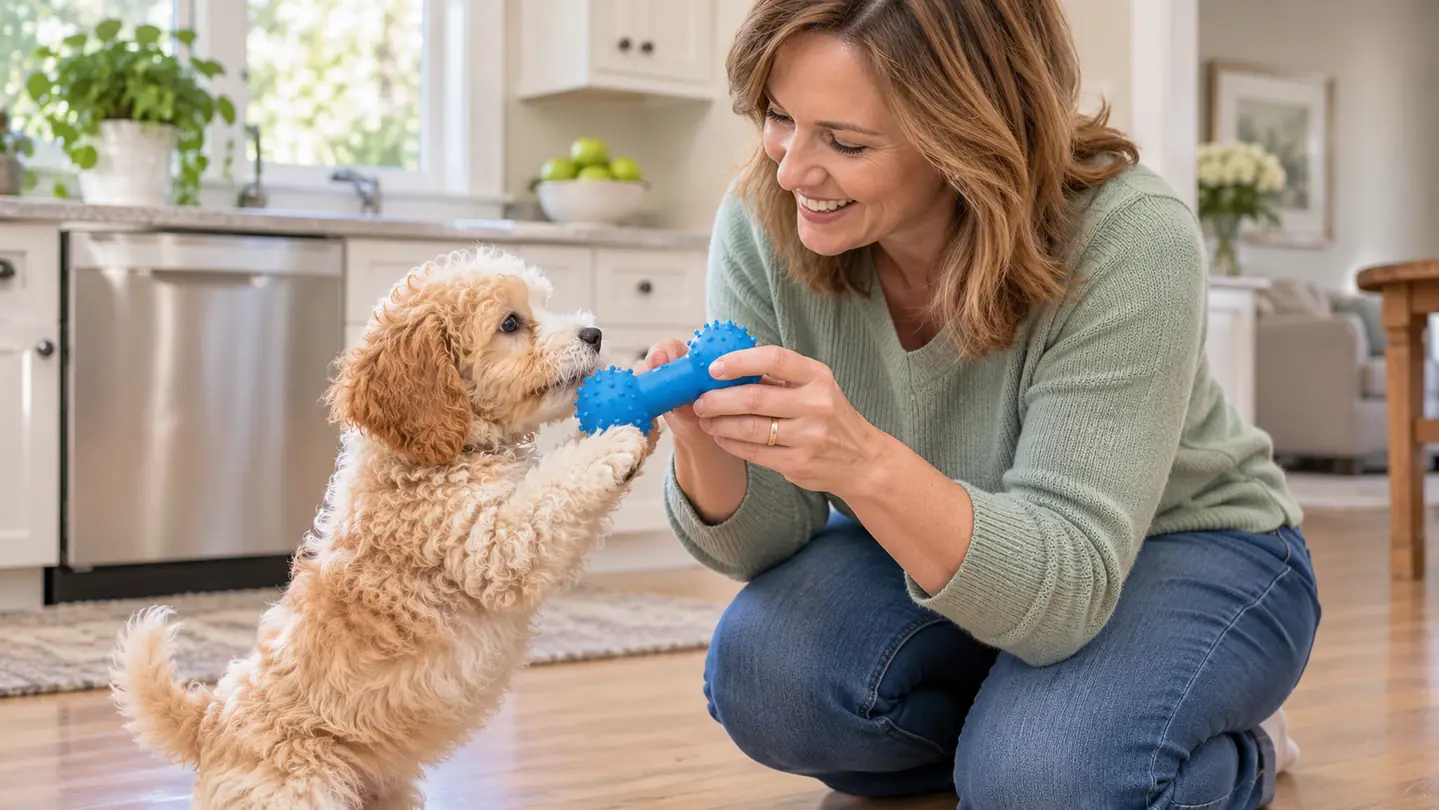
Clover is a mini goldendoodle. She weighed 6 pounds at homecoming and sits at about 21 now, with the breeder expecting 25 to 30 grown. I work four days a week as a dental hygienist, out the door before seven, so the mornings have to run themselves. The KONG became part of that routine almost immediately: I stuff it the night before with softened kibble and a spoonful of plain pumpkin our vet said was fine, freeze it overnight, and hand it to her when she goes in the crate.
That is its job. Not fetch, not tug, not a cure for puppy energy. It is the thing that occupies her mouth for twenty minutes while I get my shoes on without a small animal attached to my ankle. Everything else I have tried for teething has either been too hard, too soft, or interesting for about ninety seconds.
But the first two weeks looked nothing like that. I did not stuff it at all in the beginning. I soaked a small handful of her kibble in warm water for ten minutes, mashed it with a fork, smeared it around the inside, and froze it flat on a plate. That was the whole recipe. A nine-week-old puppy does not need a project, she needs a surface to press her gums against. The first time I handed it to her she sniffed it, walked away, and came back about four minutes later to lie down with it between her front paws. That was the entire introduction.
June was the worst month. She was somewhere around 12 pounds and dropping incisors, and she wanted to chew on everything that was not a chew toy. I tried the frozen rolled sock trick that everyone mentions. It worked for about ten minutes and then the sock went soggy and she lost interest entirely. What actually held her attention was the KONG, cold from the freezer, with the stuffing still frozen solid. She would work at it on the living room rug while I ate breakfast standing up at the counter, which is the honest version of how my mornings went in that stretch.
By July she had a routine of her own. She takes it out of the crate in the morning, carries it to the rug in front of the couch, and settles down with it. I stopped putting it away. It lives on the floor next to the crate now, and I wash it every couple of days plus always after a stuffed one. From April through about July it came out three or four times a day. Now she gets it once in the morning, sometimes again after dinner if she is restless. She still works on it with real focus. She has not put a tooth through it, split it, or bitten off a piece, and I check it every time I wash it.
Why the Rubber Matters More Than Anything Else
Here is the thing I did not understand before April. Puppy teeth are not small adult teeth. They are sharp, they are loose, and they hurt, and a puppy chewing on something rock hard is not soothing anything. The KONG Puppy is made from a softer rubber than the standard adult version, and that difference is the entire reason it works in those first months rather than sitting in a bin until the dog is a year old.
When I press a thumbnail into it, it gives. Not a lot, but enough that you can feel it flex before it pushes back. Clover can sink her back teeth in and get that pressure relief without me worrying that she is going to crack something. It lists at 6.3 inches long, 3.9 wide, 2.91 tall, and 2.08 ounces, which is light enough that she was carrying it around at nine weeks without dragging it.
It also bounces. I did not expect to care about that, but on the rainy days in May when she could not go out, I could roll it across the kitchen floor and she would chase it for ten minutes. A rubber chew that doubles as an indoor fetch toy earns its spot in the rotation.
The inspection habit is the other half of this. Once a week I hold it up to the kitchen window and bend it in both directions, then run my thumb around the inside where her back teeth work hardest. Seven months in, there is no cracking at the edges and no thinning I can feel. I cannot tell you it will never fail, because any rubber can fail, and I do not leave it with her when I am not in the room. What I can tell you is that the soft compound has not gone sticky or chalky the way cheap rubber does after a summer in a laundry room.
Seven months in, at 21 pounds, she still works on it for twenty minutes at a stretch. That is twenty minutes I get back every single morning.
How I Stuff It, and Why Frozen Matters
The listing calls it stuffable, and that is the feature that turned a good chew into an essential one. My routine is simple: about a quarter cup of her regular kibble, softened in warm water until it mashes, plus a spoonful of plain canned pumpkin, packed in with a butter knife, then into the freezer overnight on a small plate that lives in the door of the freezer now.
Frozen is the whole trick. A room-temperature stuffed chew is gone in four minutes. A frozen one buys me twenty to thirty. In the early weeks that was the difference between a calm crate and a puppy standing at the baby gate complaining while I backed out of the driveway.
I did try a smear of peanut butter once, out of curiosity, and it was gone in about ninety seconds because it does not freeze hard. Kibble and pumpkin freeze into something she has to actually work for. That is the difference between a distraction and a snack.
Two practical notes. First, it is not water resistant, so this is not a pool toy or a hose toy, and I do not leave it outside. Second, frozen stuffing thaws, and thawing stuffing leaks. I set it on a small mat or a folded dish towel inside the crate and the crate floor stays clean. Rinsing matters too: a soak in warm water loosens the dried kibble in the corners, and I do that before it goes in the dishwasher rather than after, because the top rack alone will not shift a cement-hard lump.
Size, Fit, and When to Move Up
I bought the Small, which was right for a 6 pound puppy and is now at the edge of right for a 21 pound one. This is the honest limit of the review. Small is sized for small puppies, and if your dog is headed for 25 to 30 pounds like Clover, you will want to step up to the next size before you strictly need to. I am planning that move now. I have not bought it yet, so I cannot tell you how the bigger one compares.
The weight timeline is the part I wish someone had written down for me. Six pounds in April, roughly 12 by early June, about 17 by August, and 21 now in November. The chew that felt generous in April started feeling like a mouthful around September. That is four months of comfortable use out of one Small, and I do not think I lost anything by waiting to size up until the fit actually changed.
The width is the thing to watch, not the length. A chew that a puppy can get her whole mouth around is comfortable. One she has to stretch her jaw for is not, and that is when chewing moves from soothing to frustrated gnawing at the narrow end. If your puppy's mouth clears the Small easily and she is starting to work the tips instead of the middle, that is your signal, and it usually arrives before the weight chart says so.
One more thing on fit: the listing says small breed recommendation, and I would read that as small puppy rather than small adult dog. A 9 pound adult dog that is done growing does not need the softer puppy rubber at all. The softer compound is a temporary tool for a temporary mouth.

The Parts I Don't Love
It picks up lint. The soft rubber has a slightly tacky feel that grabs hair and fuzz, and when it comes out of the dishwasher basket there is usually a strand of something on it. Ten seconds under the tap, no big deal, but it is not the self-cleaning chew I apparently hoped for.
And it is not indestructible, nor is it sold as such. I supervise her with it, always, and I take it away when she starts working a single spot with her back molars instead of gnawing around the whole thing. That is not a knock on the toy. It is just the truth about any rubber chew and any determined puppy, and Clover is a determined chewer.
What I Liked
- Softer rubber gives a teething puppy something to actually sink teeth into
- Survived seven months of daily chewing with no splits, tears, or missing pieces
- Stuffable, so it doubles as a slow breakfast and a crate distraction
- Bounces, which makes it usable for indoor fetch on rainy days
- Goes in the top rack of the dishwasher and comes out clean
- Light enough at 2.08 ounces that a nine-week-old puppy can carry it
Where It Falls Short
- The Small size tops out fast for a puppy headed for 25 to 30 pounds
- Not water resistant, so it cannot be a hose or pool toy
- Frozen stuffing leaks as it thaws unless you set it on a mat
- Soft rubber collects lint and hair in the dishwasher basket
- Still requires supervision with a hard chewer
Who This Is For
You are bringing home a puppy in the next few weeks and you want one chew that covers teething, crate time, and a rainy afternoon, without buying five things to figure out which one works. You want something you can wash in the dishwasher and stuff with your dog's own food. You are fine supervising, because you already know that is the deal with any chew. If that is you, buy the size that matches your puppy's current weight rather than the weight you hope she reaches, and plan on buying the next size up in a few months. That is exactly what I am doing.
Who Should Skip It
If your dog is already past the teething stage, skip the puppy version and go straight to the adult rubber, because the softer compound is wasted on a dog with a full set of permanent teeth. If your puppy is a serious power chewer who destroys plush toys in an afternoon, this will not be the thing that outlasts her, and you should ask your vet about what hardness is appropriate. And if you are looking for a toy to leave in the yard unattended, this is not it, since it is not water resistant and it is not meant to be out in the weather.
One chew, seven months, no replacements. That math works for me.
Small fits puppies in the 6 to 20 pound range and the soft rubber is built for a mouth that is still changing. Stuff it, freeze it, and get your mornings back.
Amazon Check Today's Price on Amazon →