
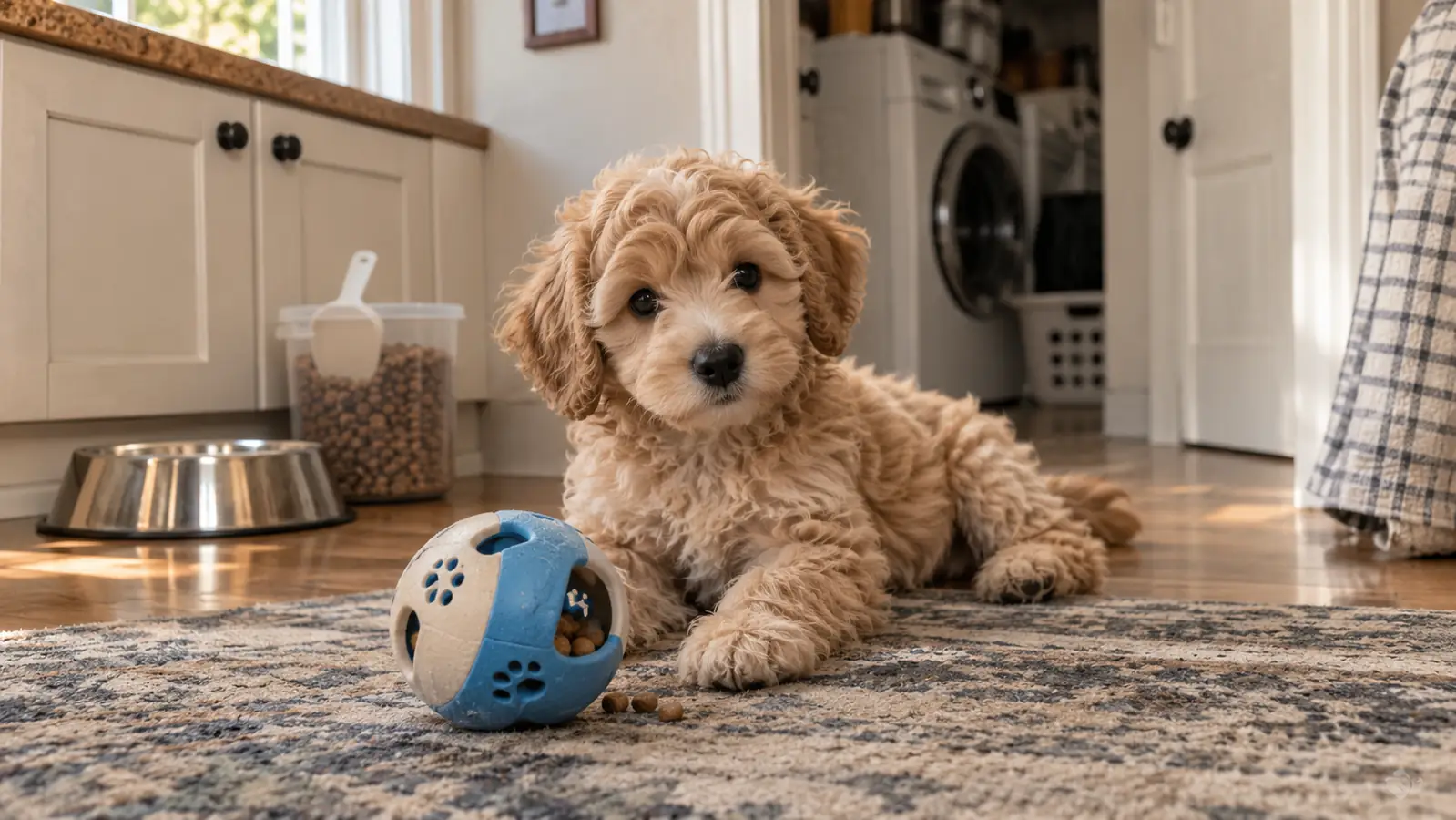
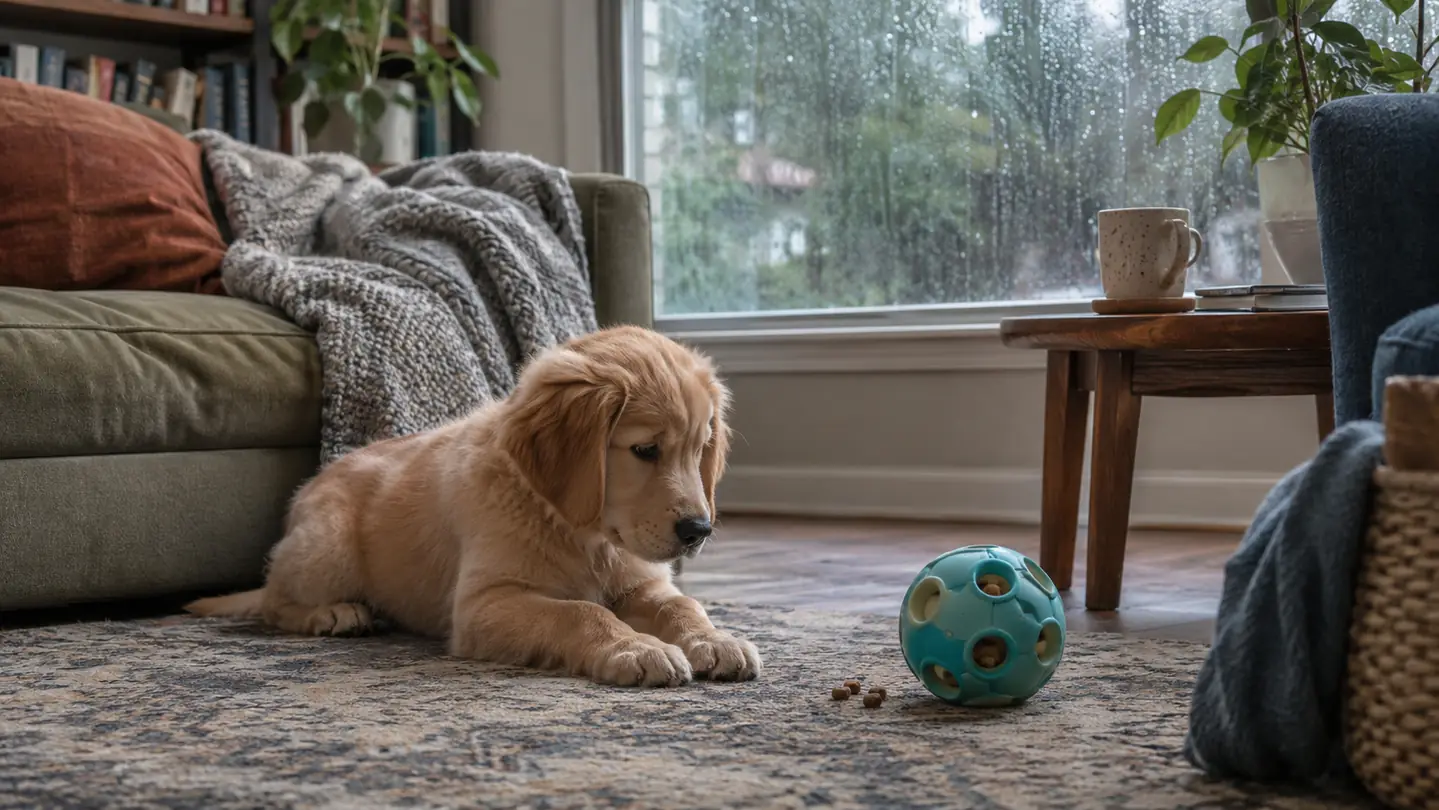
On the last Friday in May, it rained from breakfast until dinner, and Clover, seven weeks home from Indiana and still very much a puppy, treated the living room like a racetrack. She had a frozen KONG, a pad by the back door, and a yard that was too wet to use. None of it was going to burn off the kind of energy that comes from being stuck inside. I needed something that would make her use her nose and her brain, not just her legs. That afternoon I ordered the Outward Hound Nina Ottosson Treat Tumble, small, and it arrived two days later.
I bought it on May 30, 2026. It was my first puzzle toy, and I picked it for two boring reasons: it was labeled Level 1 beginner, and it was small enough for a puppy who was still growing into her frame. The Outward Hound ball is listed at 4.75 inches and 5.29 ounces, which is light enough for her to push with her nose but not so small that I worried about her losing it under the couch. I did not want a puzzle that required me to supervise every second, and I did not want one she would solve once and ignore.
The Quick Verdict
A simple, well-sized Level 1 puzzle ball that turned breakfast into fifteen quiet minutes. It is not a chew toy, and that is the one rule you cannot ignore.
Amazon Check Today's Price →Breakfast can be a job, not a race
Clover works her kibble out of the Outward Hound Treat Tumble most mornings. If your puppy inhales meals and needs a beginner puzzle, start here.
Amazon Check the current listing on Amazon →How I've Used It
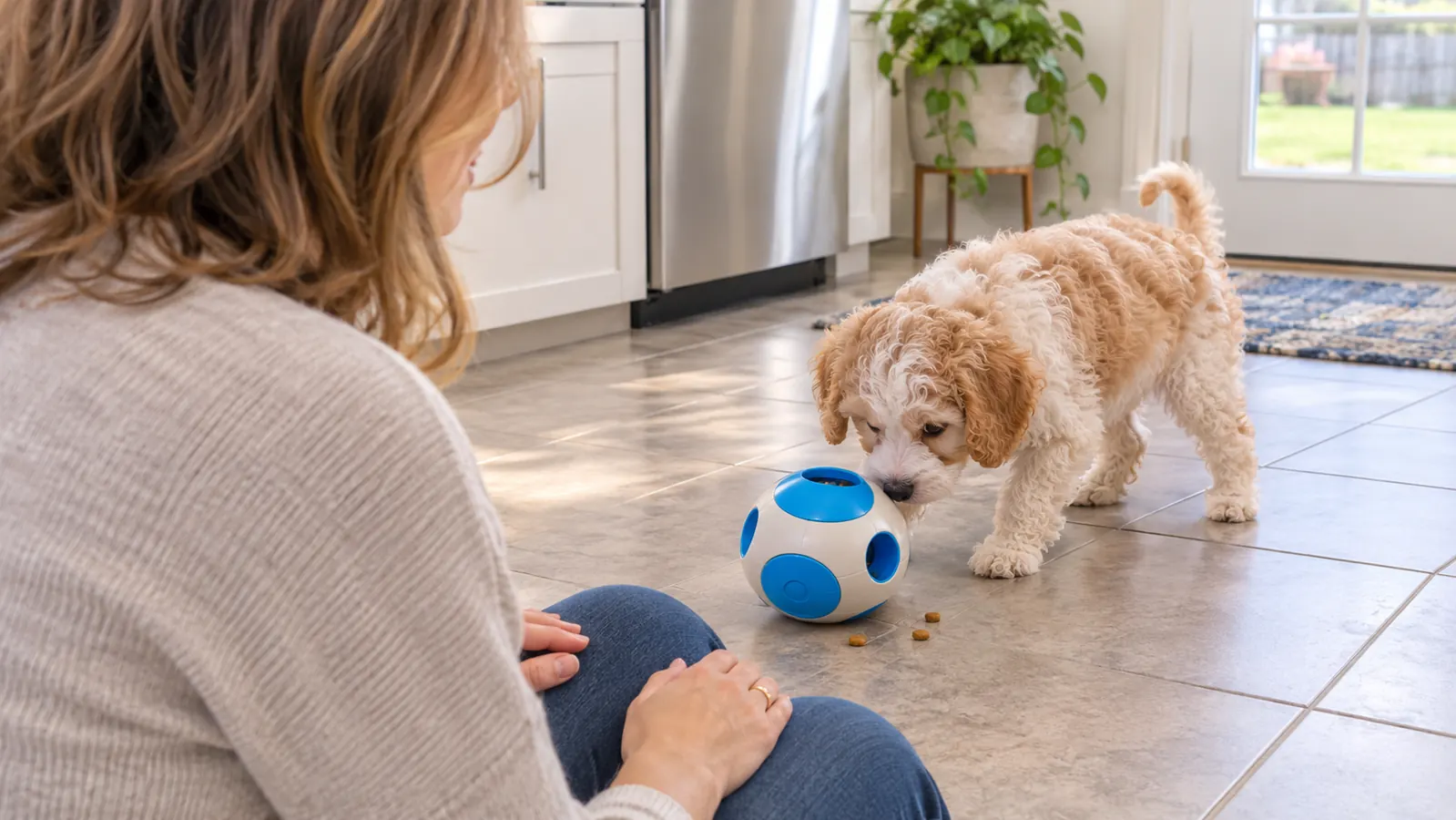
The Treat Tumble lives in the cabinet next to the kibble scoop. Most mornings I fill it with part of Clover's breakfast, set it on the kitchen floor, and finish my coffee while she works. She bats it with one paw, noses it under the dining chair, and eats the pieces that fall out. The first time I gave it to her, she solved it in about four minutes. That sounds like a failure for a puzzle, but it was exactly what I wanted. A beginner puzzle should let a puppy win.
At 4.75 inches and 5.29 ounces, it is easy for me to pick up and easy for her to move. It rolls on the kitchen tile and on the living room rug. On tile it clatters when it hits the cabinet, so I do not use it at 5:30 in the morning if Dan is still asleep. On the rug it is quieter but slower, which makes the game last a little longer. The listing includes tips for adjusting difficulty. I have kept it simple because Clover is still a puppy, and a frustrated dog is not a tired dog.
During the first week, I fed her entire breakfast in it twice. That was a mistake. She got frustrated when the kibble slowed down, and I got tired of resetting it. Now I use part of her meal, maybe a third, and put the rest in her bowl. That keeps the game fun and keeps her from getting possessive over the ball. If your puppy is new to food toys, start with a small amount and build up.
One morning in early July I set it down and walked to the bathroom to get ready for work. When I came back eight minutes later, she had it wedged against the laundry room door and was working at the opening with her front teeth. Nothing broke, and I traded her a frozen KONG to get it back. But it reminded me that a puzzle ball on the floor is a puzzle ball within reach of a mouth, and the cabinet is thirty seconds away. Now it comes back up with me the same way the KONG does.
I use it most mornings and on rainy afternoons, but not as a babysitter. The rule at our house is simple: if she starts chewing on it instead of rolling it, it goes back in the cabinet. The listing says it is not water resistant, so I wipe the outside with a damp cloth instead of washing it in the sink or the dishwasher. After five months, it still looks like a puzzle ball that a puppy has been pushing around. No cracks, no missing pieces, no reason to replace it.
What a Level 1 Puzzle Ball Actually Does for a Puppy
The Treat Tumble is a treat dispenser, not a chew. You put kibble or small treats inside, and the dog nudges and rolls the ball to get them out. The listing says 15 minutes of brain-engaging play equals 30 minutes of physical activity. I do not have a lab in my kitchen, so I cannot prove that number. What I can tell you is that after a session Clover is calmer. She is not wiped out like she is after a 20-minute walk around the neighborhood. She is settled. For a puppy who gets the zoomies at 7 p.m., settled is worth something.
Food is the other part of it. Clover is food motivated, which is a polite way of saying she thinks every meal is a race. When her kibble goes into the Treat Tumble, she has to slow down and think. She cannot inhale it. She has to problem-solve. That is the whole job of a Level 1 puzzle, and it does that job without asking me to sit on the floor and cheer.
I also like that using it does not require a routine. I fill it, she rolls it, I pick it up. There are no extra steps between me and a quiet puppy. If you have ever owned a puzzle with four removable pieces, you know why this matters. The simpler the toy, the more likely I am to actually use it on a Tuesday.
Fifteen minutes of nose work bought me a puppy who would settle on the rug while I answered email. That was the real win, not the puzzle.
The Parts That Annoyed Me
It is not perfect. The first thing you notice on a hard floor is the noise. The ball is light, but it still clatters when it hits the baseboard or the cabinet. If your puppy likes to push it under the couch, you will be on your knees more than you planned. Ours spends a lot of time under the dining table, which is fine for Clover and annoying for me. Twice I have fished it out from behind the couch with the handle of a broom, because my arm does not fit and Clover stands there watching me as if I am the one who made the mess.
The bigger issue is the chewing. This is a puzzle, not a chew toy. Clover is a determined chewer when she is teething, and she will mouth the ball when the treats stop coming. I learned that the hard way in June, when I left it on the floor after dinner and came back to find tooth marks on the rim. They are cosmetic and the ball still rolls true, but now it goes up with the bowl. I do not leave it down after breakfast. I do not use it as a crate toy. If your puppy is a power chewer, this is not the toy you leave alone with them. That is not a flaw in the design. It is just the wrong job for this object.
The listing puts it at small breed size, and I think that is fair. Clover is about 21 pounds now, and the ball is still a good fit for her. A larger dog might find it too small to bother with, or might push it around so hard that it becomes a projectile. The Amazon rating is 4.2 out of 5 from more than 13,000 ratings, which tracks with my experience. Most people like it. Some dogs ignore it. Neither of those is a scandal.
The other thing is the filling. You need treats or kibble that fit through the opening and still rattle around enough to be worth chasing. If the pieces are too big, nothing comes out and the puppy loses interest. If they are too small, the game is over in a minute. Clover's kibble is the right size. I have also used a few broken training treats, which worked but made the ball smell like liver. That is not the ball's fault.
What I Liked
- Clover solved it on day one, so it works as a true beginner puzzle.
- Holds kibble for breakfast and slows down a fast eater.
- Light enough for a small puppy to push and easy for me to pick up.
- Takes up little cabinet space between uses.
- The included tips let you adjust difficulty without buying another toy.
Where It Falls Short
- Not water resistant, so it cannot go in the dishwasher or a water bowl.
- It is a puzzle, not a chew toy, and must be put away when mouthing starts.
- Clatters on hard floors and rolls under furniture.
- Too easy for dogs who already solve puzzles, and too small for some larger dogs.
How It Fits With the Rest of Our Puppy Gear
The Treat Tumble did not replace anything. It added a job. Our KONG Puppy, which we bought two days after Clover came home, is still the toy that goes in the crate and the toy that gets stuffed and frozen for teething. The Treat Tumble is the breakfast toy and the rainy-day toy. One is for chewing and quiet crate time. The other is for thinking and eating. If you are trying to decide between them, that is the cleanest way I can put it.
I have never owned the KONG Wobbler, so I am not going to pretend I tested them side by side. I know it from the pet store aisle and from listings. My sister-in-law keeps one for her dog and swears the tipping motion is what her dog loves. That may well be true. I only know that I already had a rolling ball that Clover understood on day one, and I did not need a second food toy taking up cabinet room. What I can tell you is that the Outward Hound Treat Tumble is the one that earned counter space in our kitchen. It is small, it is light, and it does one job well. That is more than I can say for half the puppy gear in our laundry room.
The other thing I like is that it gives Dan a job on his work-from-home days. He can put a handful of kibble in the ball, set it on the kitchen floor, and buy himself fifteen minutes on a call. He does not reach for it every day, and he does not use it when she is already wound up, because a wound-up puppy just knocks it across the room and barks at it. It works best when she is calm enough to think. That is not a training plan. It is a small tool that makes a puppy day easier. I will take that.
What Five Months Has Changed
When I bought the Treat Tumble, Clover was still small enough to fit under the dining table without ducking. Now she is about 21 pounds and the breeder expects 25 to 30 grown. The ball has not changed size, but she has. In June she had to chase it across the whole kitchen to keep it moving. Now she can trap it against the cabinet with one front paw and hold it there, which she could not do at ten pounds. That is not a flaw in the ball. It is what happens when the puppy grows and the puzzle stays at Level 1.
That is the honest tradeoff with a Level 1 puzzle. It does not grow with your dog the way a training plan does. The included tips can make it a little harder, and you can pack the treats tighter or use bigger pieces, but it is still a beginner toy. If I had a dog who solved it in thirty seconds and walked away, I would move on to a Level 2 puzzle. Clover still noses it around for five or ten minutes, so we are not there yet.
The condition after five months is fine. I have wiped it down, picked it up off the kitchen floor, and put it away more times than I can count. There are no cracks and no sharp edges. It has been dropped, rolled into the hallway, and pushed under the couch. The one thing I have noticed is that the opening collects a little kibble dust, so I wipe inside it with a damp cloth about once a week. For a lightweight toy that gets used most mornings, it has done its job.
Who This Is For
This is for the puppy owner who has a food-motivated dog and wants a first puzzle that will not require a manual. It is for the person who feeds kibble and would like mealtime to take eight minutes instead of ninety seconds. It is for the household where it rains for three days straight and the puppy still needs a job. It is also for the owner who wants a toy they can wipe down and put in a cabinet, not a contraption with six parts to wash.
Who Should Skip It
Skip it if your puppy is a power chewer who will treat the ball as a chew toy. Skip it if your dog already solves Level 2 or Level 3 puzzles and gets bored when the answer comes too easily. Skip it if you want a toy that can be left in the crate or the yard, because this is not that toy. And skip it if you are looking for a replacement for training or walks. It is a puzzle, not a puppy sitter. It does one job, and it does that job well, but it will not raise your dog for you.
If your puppy needs a job at breakfast, start with Level 1
The Outward Hound Treat Tumble is the puzzle I reach for on rainy mornings and busy weekdays. It is simple, it is small, and it has held up to five months of Clover.
Amazon See the Treat Tumble on Amazon →