
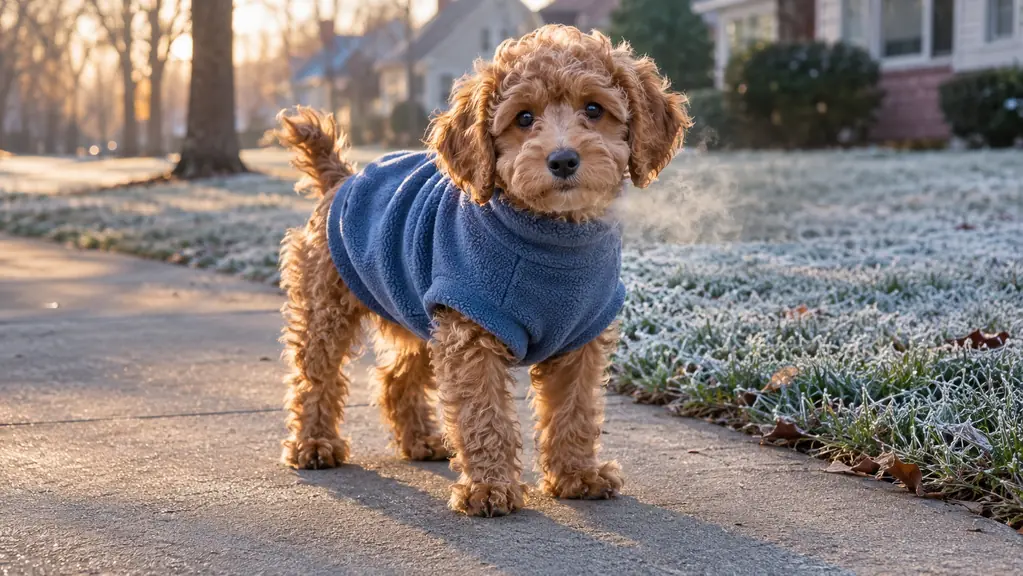
Clover came home in April at nine weeks old and six pounds, and by the first week of October she was a twenty one pound mini goldendoodle who still acted like a puppy in almost every way. One thing had changed without me noticing. She got cold. The first really frosty morning we walked to the end of the driveway and she sat down. Not the stubborn sit she does when she wants to sniff something. A cold sit. Tail tucked, ears flat, one front paw lifted off the pavement. We turned around and went back inside, and I spent the rest of that day reading sweater listings on my phone.
I ordered the JECIKELON fleece sweater that evening in size large, and it showed up at the end of the week in a plain poly bag. It is 100 percent polyester, pull on, with a round neck and a letter print pattern, and it weighs almost nothing at 1.76 ounces. Five weeks of near daily wear later, I have a short list of things I wish someone had told me before that first cold morning. That list is this article. The sweater has been fine. My technique needed work.
The one she stopped sitting down in, five weeks of morning walks later
JECIKELON's fleece pull-on comes in six sizes from XX-Small to X-Large and weighs less than two ounces, so a puppy who does not love being dressed barely notices she is wearing it.
Amazon Check Today's Price on Amazon →Step 1: Measure the Chest Before You Order Anything
A sweater size is not a weight. That is the mistake I nearly made. Clover was sitting right around twenty pounds when I ordered, and I almost picked a medium because that is roughly what medium means in people clothing. The JECIKELON listing does not work that way. The sizes run from XX-Small to X-Large, and the number that actually decides it is the chest girth, measured all the way around the widest part of the rib cage, just behind the front legs.
Use a soft cloth tape, the kind that lives in a sewing kit, because a stiff metal tape from the garage will not curve around a wiggly puppy. I measured Clover standing up with one hand under her belly to keep her still, and got fifteen inches around the chest and about ten at the neck. Working from the size chart, that put her in a large, and that is what I ordered. If you get one thing on this whole page right, get this one right.
I tried the metal tape first, because it was in the kitchen drawer and the sewing kit was upstairs. I got one reading of sixteen inches and a second reading of thirteen and a half, which is not a measurement so much as a coin flip. What I learned is that a stiff tape bridges the dip behind the shoulder blades and reads long, then slips when the puppy leans away and reads short. The cloth tape gave me fifteen inches three times in a row. Three matching readings is the bar I would set before ordering anything.
Two notes before you buy. Puppies grow, so a fit that is perfect in November can be snug by January, and a chest that measures seven inches this week will not measure seven inches in three months. Measure again before a second purchase. And if your puppy lands between two sizes, go up and then check the neck opening before you commit. A sweater that is slightly roomy is easy to live with. One that will not clear the head is not.
Step 2: Put It On Without a Wrestling Match
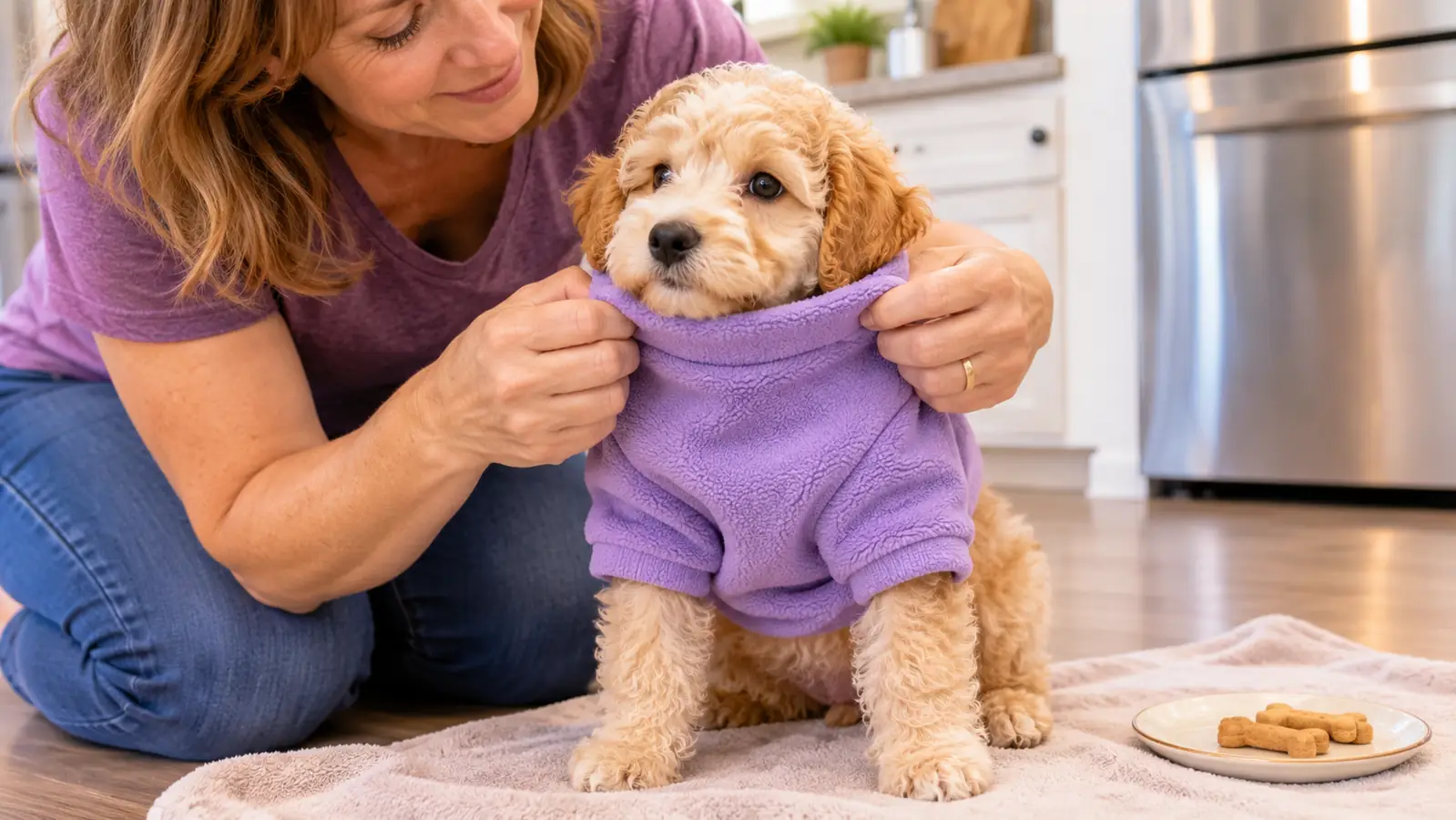
Clover hated the sweater for exactly two walks. The first time I brought it toward her, she backed under the kitchen table and gave me a look like I had produced a nail trimmer. This is normal. A pull-on goes over the head, and a puppy has no way of knowing that the thing swallowing her face has a hole at the other end.
What worked was treats and speed, in that order. I put a piece of kibble on the floor, waited for her head to drop, and slid the neck over her head while she was still chewing. Then one front paw in, then the other, then I stood her up and eased it down over her back. The whole thing takes about six seconds once you both know the routine. The first attempt took closer to a minute and involved me apologizing out loud to a dog.
The first morning we actually wore it outside was October fourth, and it went badly in a small way. I put the sweater on in the kitchen, which was fine, then opened the back door and she froze on the threshold like the cold had personally insulted her. I put a piece of kibble on the top step, then another on the walkway, and by the fourth piece she was off the porch and moving. Now she stands at the door and waits for it, which I did not see coming.
Do it indoors, on a floor with some grip, and do it before the leash comes out. A puppy who is already wound up for a walk has no patience for a garment. If yours is genuinely frightened rather than merely suspicious, stop, feed a treat, and try again after a nap. There is no prize for winning the first round, and a bad first association follows you for weeks.
Step 3: Check the Fit in Three Places
Once it is on, run your fingers under the neck opening. Two fingers should slide in comfortably, no more and no less. On a pull-on, the neck is the part that either feels safe or feels like a choke point, and it is the first thing to check. Clover's head goes in and out easily and the neck sits flat instead of gaping open.
Next, look at the chest. The fleece should touch her sides without pulling tight across the ribs. If the letter print pattern is stretched out of shape across her back, it is too small. If the whole thing hangs off her like a curtain and she keeps stepping on the hem, it is too big. Then check behind the front legs, where a bad fit rubs first. A light polyester fleece at 1.76 ounces will not weigh her down, but any fabric will work a raw spot if it bunches in that crease.
The last check is movement. Let her walk across the room and actually watch. She should be able to trot, squat and turn without the sweater riding up her back or twisting around her middle. Clover did a stiff legged little march for the first thirty seconds and then forgot about it entirely. If yours is still walking like a wind up toy after five minutes, the fit is wrong, not the puppy. The squat is the real test, and it took me a week to trust it. The first time she stopped mid walk to pee, I held my breath, and the sweater stayed put across her back instead of riding up over her ribs. That is the moment I stopped fussing with it on every walk.
Five weeks of walks and the only thing that ever came loose was a leaf stuck to her back. The sweater stayed exactly where I put it.
Step 4: Time the First Walks
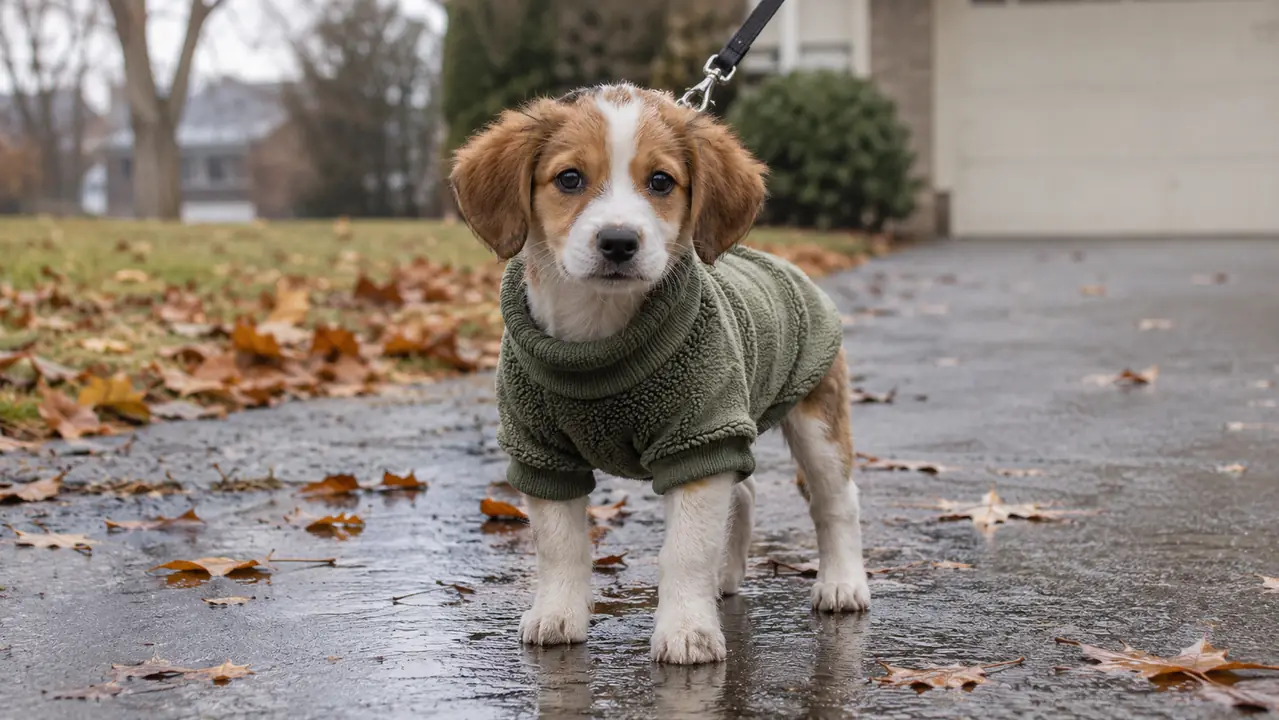
I use the sweater for morning and evening walks when it is under about 45 degrees, which in central Ohio starts in mid October and keeps going until roughly March. Our neighborhood loop is about twenty minutes. For the first several walks in the sweater I deliberately cut them short, ten or twelve minutes, and watched her for signs of being too warm: panting, lagging, or trying to lie down in the grass halfway around.
The sweater comes off the moment we are back inside. That is not fussiness. A small dog in a fleece, standing in a heated house, is dressed for the wrong weather, and I would rather spend thirty seconds pulling it off than have her cook in it on the couch. If your puppy refuses to walk in it at all, that is information rather than defiance, and it usually means the neck or the chest is binding somewhere.
One honest limit. Five weeks is not a winter. I have not put this sweater through a January morning with a real wind chill, and I do not know how it handles wet snow, because fleece is not waterproof and it was never sold as though it were. For the cold, dry, clear mornings we have had so far, it does the job. Ask your own vet about how long your puppy should be out in genuine cold, especially a very young or very small one, because that answer depends on the dog in front of you.
Step 5: Wash It More Often Than You Think
The care instructions say machine wash, and that is what I do: cold water, a free and clear detergent, then laid flat over the back of a kitchen chair to air dry. I do not put it in the dryer. It is polyester fleece and I have ruined enough of my own fleece jackets to know better. It has been through the wash three times so far and has not pilled, stretched or lost its shape. I wash it on Sunday evenings so it has all night and most of Monday morning to dry, because air drying takes longer than you would expect for something this thin. The first time I washed it I hung it over a chair at nine at night and it was still faintly cool at seven the next morning.
Frequency matters when you own one sweater and one dog. A puppy who wears it twice a day, walks through frosted grass and occasionally has an accident on the way to the back door needs it washed weekly, not monthly. There have already been two evenings when the sweater was still damp over the chair and we went out without it. If I had it to do again, I would have ordered a second one on day one instead of a month in.
The letter print pattern has survived all three washes and the pull-on neck has not gone slack. That sounds like a small thing until you have owned cheap pet clothing with a neck that stretched out after two weeks and started sliding down the shoulders mid walk. Five weeks in, this one still sits where it did on the first morning.
What Else Helps
A few small habits have done as much for cold walks as the sweater itself. The first is a towel by the back door. Cold pavement means wet paws, and a quick wipe keeps the fleece from collecting grit and keeps the laundry pile smaller. Clover hates having her paws handled, so this is a two treat operation and I have made my peace with that.
The second is keeping her coat brushed. The JECIKELON sweater sits close against the body, and a tangle behind the ears that you did not notice becomes a rub point under fabric. Five minutes with the slicker brush most evenings has been enough for us, and the groomer told me in August to stay after the ears and armpits. The third is knowing when to leave it on the hook. If it is mild, if the trip is just out to the mailbox, or if she is going to be running hard at the park, the sweater stays home. It is for cold, slow, standing around weather, not every outing. Hang it somewhere you can reach without moving three of your own coats, because the mornings you cannot find it are the mornings you need it.
Order the size you measured, not the size you guessed
Six sizes from XX-Small to X-Large, pull on with a round neck, machine washable polyester fleece. Five weeks of twice daily walks and three trips through the wash later, it still fits the way it did on day one.
Amazon See the Size Chart on Amazon →