
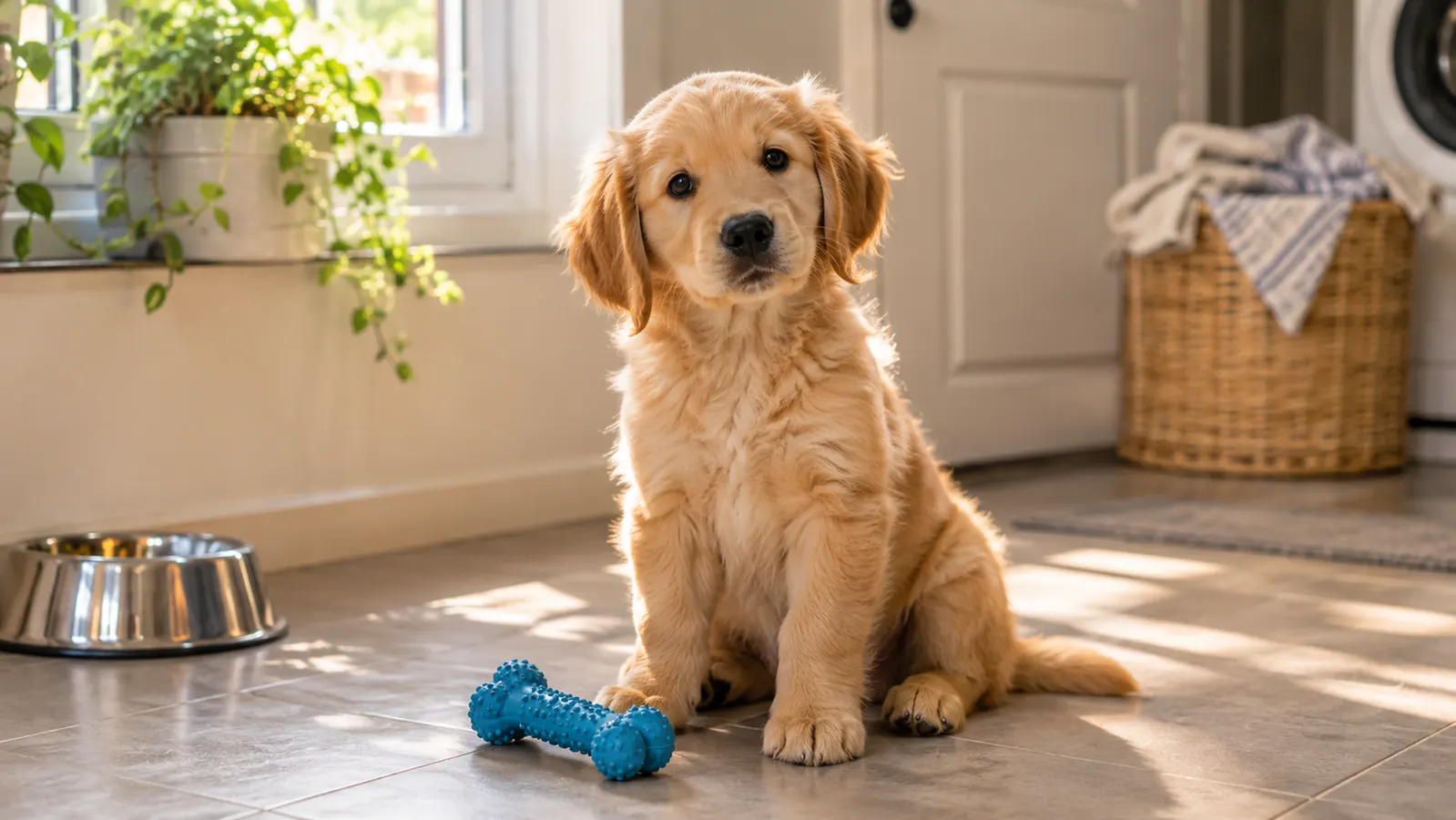
I brought Clover home on Sunday, April 12, 2026, and by Tuesday she had found the couch legs. That is not an exaggeration. A nine-week-old mini goldendoodle who weighed six pounds at homecoming can do a surprising amount of damage with tiny teeth, and my first instinct was to buy every chew on the shelf. What actually worked was smaller and more boring: a KONG Puppy in size Small, ordered April 14, two days after she came home. I have used it almost every day since. She is about seven months old now and around 21 pounds, and the Small is near the top of her range. Here is the routine that kept her gums busy and my furniture mostly intact.
Teething is not a single week. For Clover it came in waves from about three months to six months, with the worst evenings around four months. She wanted to chew constantly, but she also wanted to be near me. A chew that could be stuffed and frozen bought me quiet crate time and gave her something cold for sore gums. The KONG Puppy is not a babysitter. It is a tool, and it works best when you use it on purpose. I am not a vet or a trainer. I am a dental hygienist who likes a system, and I ran this one past our own vet when I had questions.
The chew that got us through the worst teething weeks
Small KONG Puppy, natural rubber, stuffable, and easy to keep in a rotation. This is the one I bought two days after Clover came home.
Amazon See the KONG Puppy on Amazon →Step 1: Match the size to your puppy and introduce it supervised
KONG sizes the Puppy line by puppy size, and Small is meant for small puppies. At six pounds, Clover was well inside that range. The Small measures about 6.3 inches long and weighs 2.08 ounces, so it was light enough for her to carry but big enough that I did not worry about her getting it behind her back teeth. If your puppy is already past 20 pounds or a strong chewer, look at the next size up. I am planning that move for Clover soon, but I have not bought it yet. Do not size up just because your puppy is enthusiastic. A too-large toy is hard to hold and a too-small toy gets boring fast.
Introduce it when your puppy is calm, not in the middle of a zoomie. I sat on the kitchen floor with Clover, put the KONG Puppy in her mouth gently, and let her mouth it. When she dropped it, I gave it back. That was it for day one. The goal was not to wear her out. The goal was to make the toy feel normal and safe. The natural rubber is softer than an adult chew, which is the point for a puppy's teeth, but no chew is indestructible. I supervised every session for the first month.
One mistake I made early: I left it out on the floor all day. Clover got bored with it by dinner. After that I kept two things in rotation, the KONG Puppy and a plain rope toy, and the KONG came out for crate time and quiet evenings. That small change made the toy feel special again. If your puppy is already a determined chewer, supervise and put it away when play gets wild. A chew toy is not a replacement for a potty break, a nap, or a training session.
Step 2: Stuff it with a soft puppy-safe mix and freeze it for sore gums
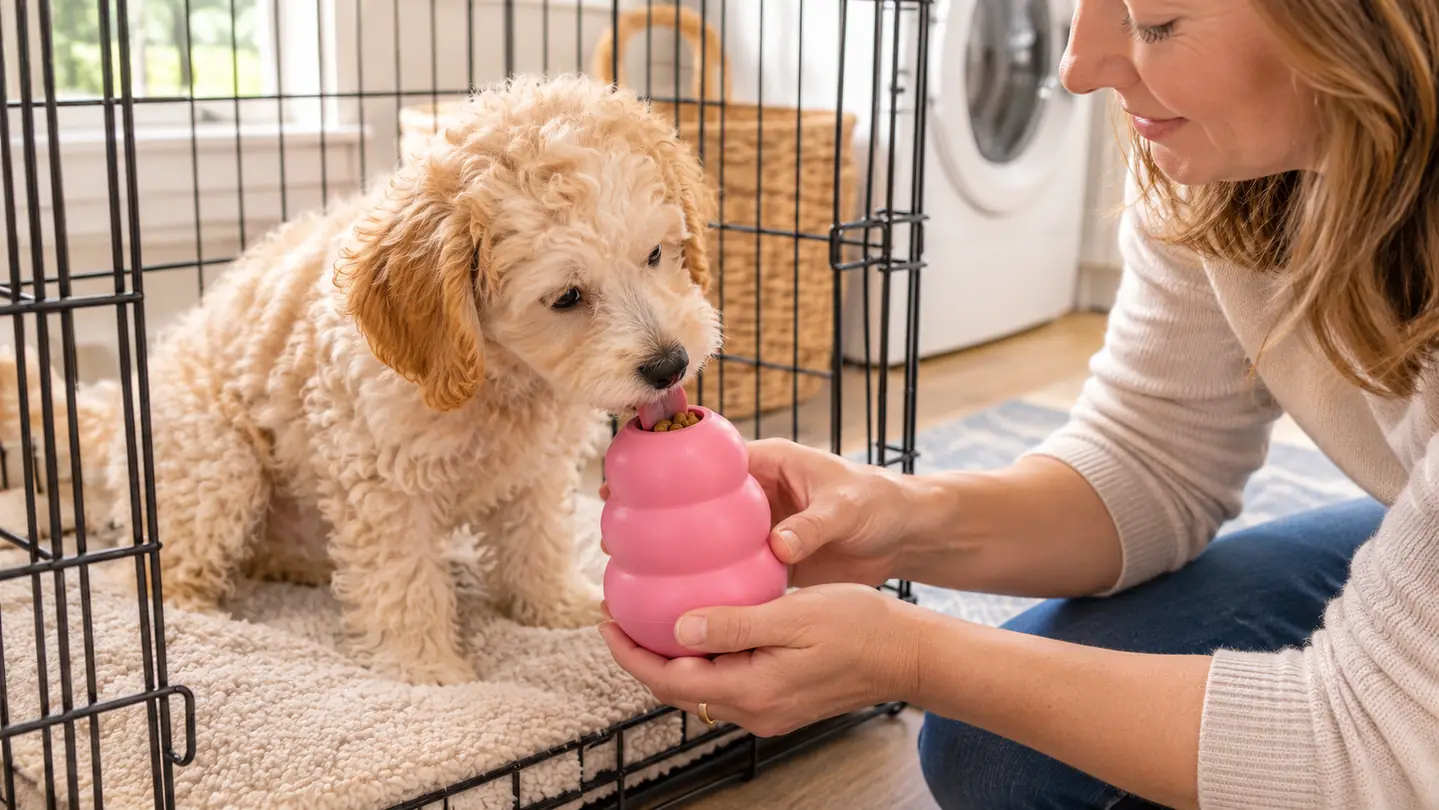
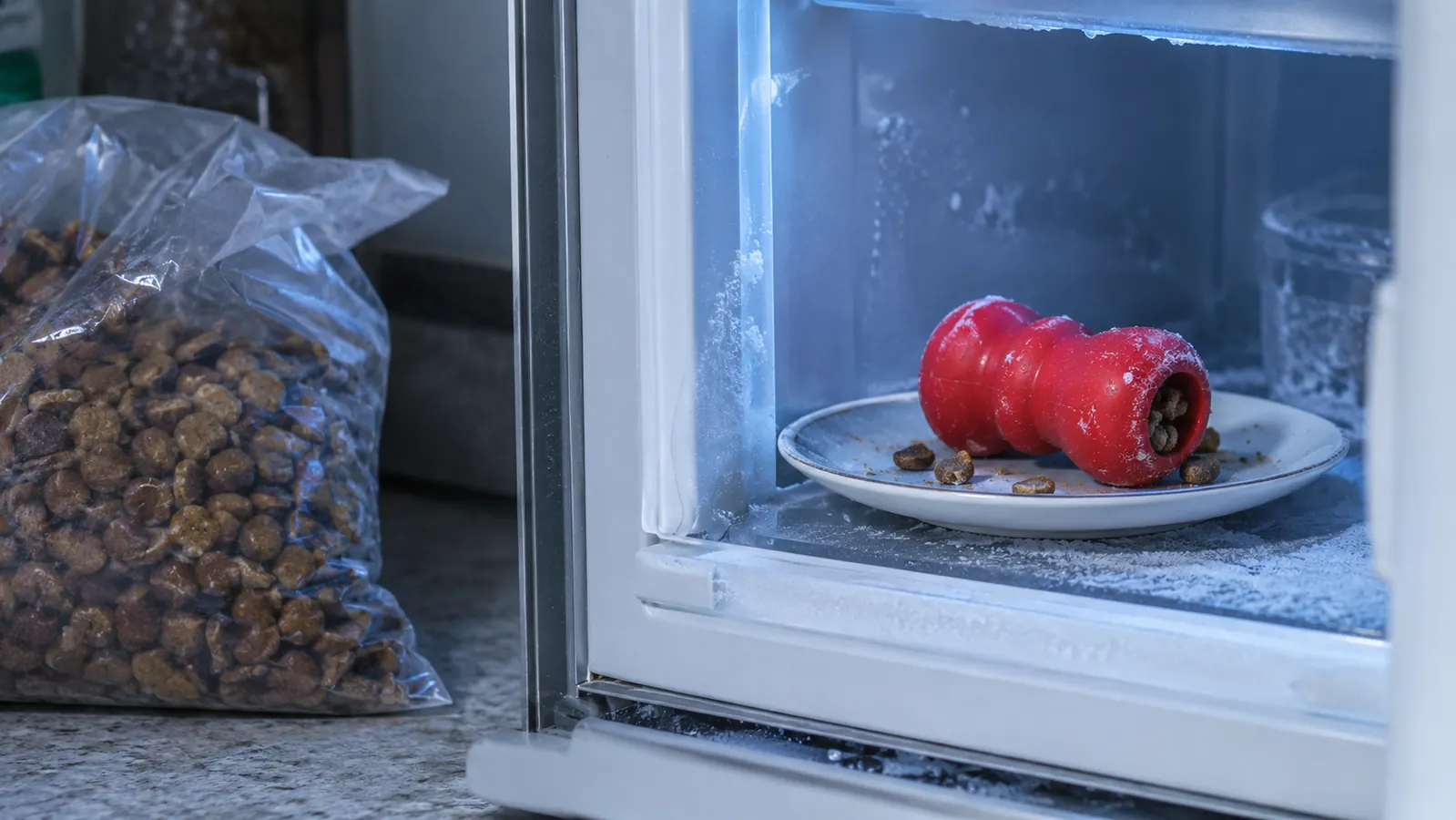
The first time I stuffed the KONG Puppy, I overdid it. I packed it tight with dry kibble, and Clover lost interest in about a minute. The better version was softer. I soaked her kibble in warm water until it was mushy, added a spoonful of plain pumpkin our vet said was fine, and mashed it together. Then I packed it into the toy, not so tight that her tongue could not reach it, and froze it overnight on a small plate. The next morning it was a cold, slow chew that kept her busy in the crate while I got ready for work.
You do not need a special recipe. Use the food your puppy already eats and ask your vet before adding anything new. The point is texture and cold, not a gourmet treat. A little plain pumpkin made the mixture hold together, but plain softened kibble works too. If your puppy has a sensitive stomach, keep it simple. I made the mistake of trying three new foods in one week, and I paid for it with a very loose morning. One change at a time is kinder to everyone.
Freeze it flat so it fits in the crate and thaws slowly. A fully frozen KONG Puppy can be hard for a young puppy at first, so I let it sit on the counter for five minutes before giving it to Clover. As she got older, she wanted it colder and harder. Watch your puppy with any frozen chew. If she seems frustrated, let it soften a little. If she loses interest, take it away and try again later. The toy should be a good experience, not a test of will.
Step 3: Build it into crate time and your workday mornings
Clover sleeps in a crate in the laundry room off the kitchen. I work four days a week, Monday to Thursday, and Dan is home three of those days. On the days I leave, the morning has a rhythm: potty, breakfast, a short walk, then crate with a frozen KONG Puppy. That sequence saved us. She learned that the crate meant a cold chew and a nap, not a long lonely stretch. I am not saying every puppy will love a crate because of a toy. I am saying the toy made the first ten minutes easier, and the first ten minutes are usually the hard part.
I also used the KONG Puppy during my own quiet time. If I needed 20 minutes to answer emails or eat lunch, I gave it to Clover on her bed next to me. She would work at it, then fall asleep. That was the whole plan. It was not fancy. The key was consistency. The toy came out at the same times, and it went away when she was done. By four months, she would run to her bed when she saw me take it out of the freezer.
A word about supervision. The KONG Puppy is a chew toy, not a puzzle feeder you can leave in a crate for hours without checking. I check the toy before every use. If the rubber is torn or a piece is missing, it goes in the trash. I also do not leave a stuffed toy in the crate with a puppy who has a history of tearing things apart. Clover was not a destroyer, but she was determined. Supervise, check, and replace when needed.
Step 4: Use it to redirect chewing you do not want
The couch legs were the reason I bought the KONG Puppy in the first place. Clover started chewing them on day two, and I was not about to spray the furniture with anything harsh. Instead I kept the KONG Puppy within reach and traded it for the couch leg. I did not yell. I did not pull her away by the collar. I put the toy in front of her nose and praised her when she took it. Then I blocked the couch leg with a laundry basket for a week. The toy did not train her by itself. The trade did.
That trade works best when the toy is already a good thing. If your puppy has never seen the KONG Puppy, do not expect it to beat a couch leg in a fair fight. Spend a few days making the toy normal and special, then use it as the redirect. Keep a stuffed one in the freezer and a plain one in the toy basket. When your puppy grabs something forbidden, swap calmly and then give her something else to do, like a sit or a short game of fetch. The KONG Puppy has a bounce that makes it useful for fetch, so you can turn a chewy moment into movement.
I also used it for paw handling practice. Clover hates having her paws touched, and brushing her feet was a two-person job at first. I would give her the KONG Puppy while Dan held her, then touch one paw and stop. The toy did not fix the paw issue, but it gave her something else to focus on. That is the honest version. A chew toy is a support, not a solution. If your puppy is guarding the toy, stop and talk to a trainer or your vet. Guarding is not something to ignore.
Step 5: Inspect, clean, and size up before the toy gets too small
The Small KONG Puppy has held up well for us. Clover is now about seven months old and around 21 pounds, and she is at the top of the Small range. The toy is still in one piece, but I can see the wear at the top where she works at it. I check it every few days and wash it after messy stuffing. When the rubber starts to tear or the toy gets too small for her mouth, I will replace it. I have not bought the next size yet, but that is the plan. A worn chew is not worth the risk.
Cleaning matters more than people think. A stuffed toy that sits in a crate can get sour. I rinse the KONG Puppy after each use with warm water, and once the stuffing is out it goes in the top rack of the dishwasher. Check your own toy's packaging for its cleaning instructions. The point is to keep it clean and dry between uses.
Size is the part most people get wrong. The KONG Puppy Small is 6.3 inches long, which was right for a six-pound puppy. At 21 pounds, Clover can still use it, but I would not push it much further. A toy that is too small can be a choking risk, and a toy that is too large is hard to enjoy. When in doubt, go up a size and supervise. You can always keep the smaller one for a smaller puppy or retire it. Do not wait for a tear to tell you it is time.
What Else Helps
The KONG Puppy did one job well: it gave Clover a safe place to put her teeth. It did not housebreak her, teach her to walk on a leash, or stop her from chewing the couch legs when I was not looking. What else helped was a simple routine. I kept a leash by the back door and took her out on the same schedule every day. I put away shoes and cords. I gave her a potty spot in the laundry room with pads for backup, and I still keep one by the back door for storms. I also used a treat puzzle at breakfast and a slicker brush most evenings, because a tired puppy and a comfortable coat make everything else easier. If your puppy is teething hard, ask your vet about appropriate chews and anything else you are adding to their diet. And give yourself some grace. The puppy year is a lot of small decisions, and you will get some of them wrong.
The KONG Puppy did not stop Clover from chewing. It gave her a better place to do it, and that was enough.
If your puppy is chewing everything, start with the size that fits
The Small KONG Puppy is the one I bought two days after Clover came home, and it is still in our rotation at seven months. Check the size chart, supervise the first few sessions, and keep a frozen one ready for crate time.
Amazon See the KONG Puppy on Amazon →