

The first tangle I found on Clover was behind her left ear, about the size of a pea, and I found it on a Tuesday night in early May with my fingers while she worked on a chew toy. She was eleven weeks old then. Her coat had gone from fluffy to Velcro in about a week, and I had no idea what I was supposed to do about it. So I did what I always do when a small problem surprises me. I typed puppy brush into the Amazon search bar and scrolled until my eyes crossed. I ordered the Coastal Li'l Pals Slicker Brush on May 9, 2026, for two reasons. The head looked small enough for a six pound puppy, and it was inexpensive enough that I would not be annoyed with myself if I got it wrong.
That was about seven months ago. Clover is a mini goldendoodle, roughly twenty one pounds now, and this brush has been used most evenings since the day it showed up. I am not writing this after a weekend of enthusiasm. I am writing it after a coat change, a summer of burrs in the backyard, one professional groom on August 22, and a few hundred five minute sessions on the couch with the TV on. Here is what I actually think of it, including the part I complain about.
The Quick Verdict
A small, light slicker that reaches the spots a puppy actually mats: behind the ears, under the front legs, the backs of the hind legs. Six months of near daily use and not one bent pin. Buy it for the size, not for a feature list.
Amazon Check Today's Price →The brush that fits behind a puppy's ear
The head is 3.25 by 7.25 inches and the whole brush weighs under an ounce. That is why it works on ears, armpits and paws instead of skating over them.
Amazon Check Today's Price on Amazon →How I've Used It
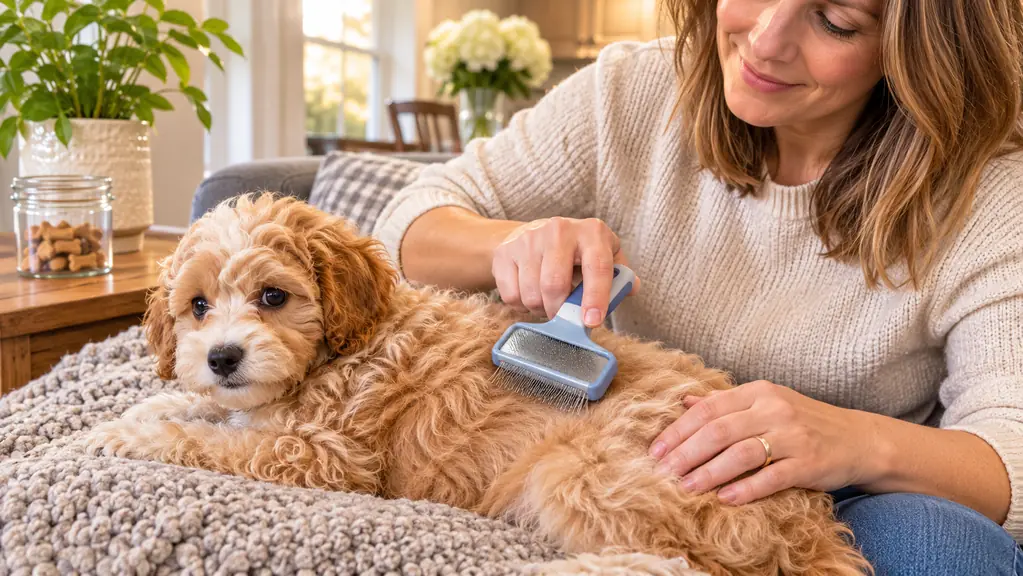
Brushing happens on the couch, most evenings, for about five minutes. I keep a small jar of treats on the side table and I put one down after each section. Behind the ears first, because that is where the tangles live. Then the armpits, then down the legs, then a quick pass over the back and tail. Clover lies still for the first three minutes and starts getting up during the last two. That is about right for a puppy her age and I have stopped expecting a show dog level of patience.
The hard part was never the brush. It was the paws. Clover hates having her paws touched and she still does. So the leg work is short and bribed. One leg, treat. Next leg, treat. If she pulls away I stop and pick it up the next night rather than win the argument. Six months in, she will let me do all four legs without a treat in my hand, which I count as one of the better things that has happened in this house this year. The brush helped with that only because it is small enough that finishing a leg takes ten seconds.
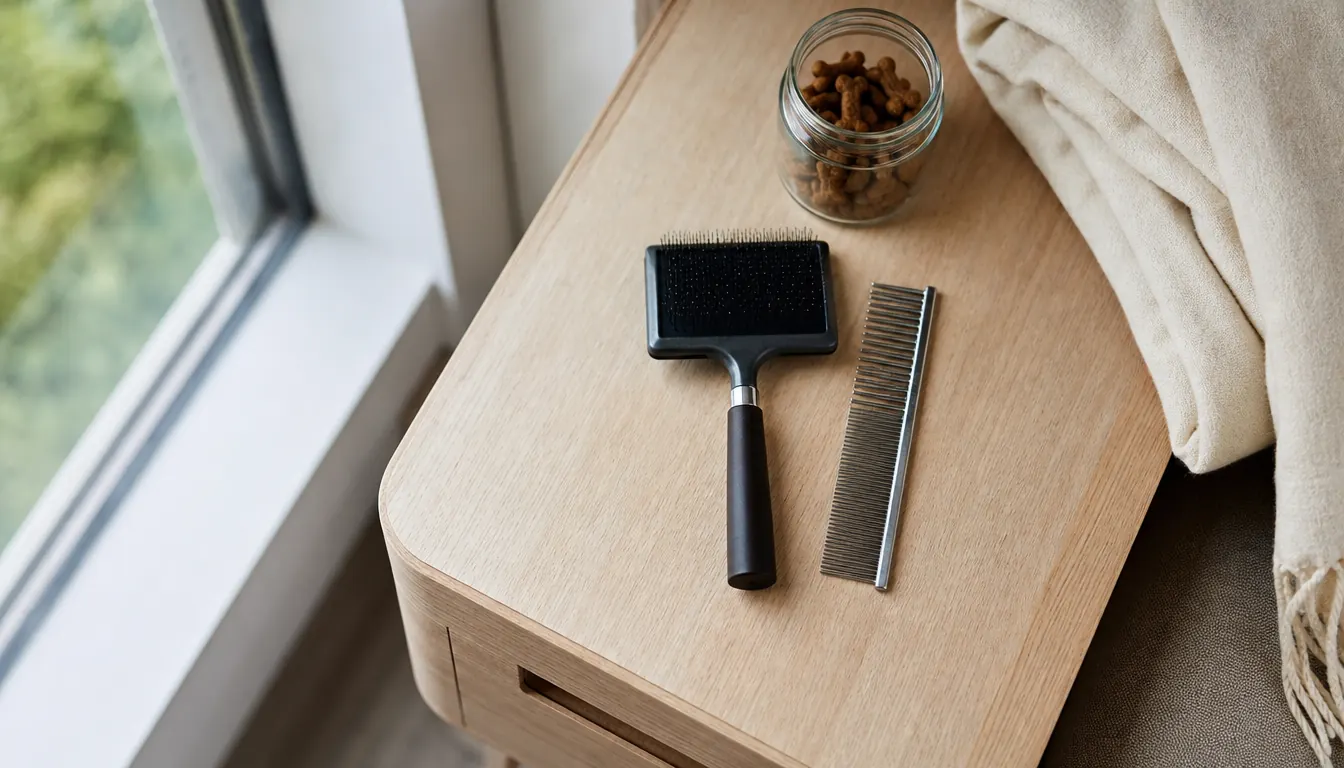
When I finish, I run a cheap steel comb I bought at a pet store over the same spots. The comb is not there to do the work. It is there to check the work. If the comb glides, I am done. If it catches, I go back in with the slicker. I did not start doing that check until July, and it is the single reason I caught a knot behind her front leg while it was still a knot and not a mat. Five minutes of brushing plus two minutes of checking is my whole routine, and it is more effective than the twenty minute sessions I attempted in the beginning and quit halfway through.
What the Brush Actually Does to a Puppy Coat
The working part is the row of flexible wire pins with coated tips. The ends are rounded, and the point of that is to let the pins glide along skin instead of scratching it. I have run this over Clover's belly and the inside of her back legs, which is thin skin, and she has never flinched at the brush itself. She has flinched at me holding her paw. That is a completely different situation and no brush on the market fixes it.
The pins sit in a rectangular head that measures 3.25 by 7.25 inches, and the whole brush is under an ounce. That sounds like a line off a spec sheet and it is not. A puppy mats where the body bends. Behind the ears. Under the front legs. The armpit. The back of the hind legs. Those are small, awkward, bony areas. A big brush skates over them and misses the exact spot you bought a brush for. A head this size sits in them and stays there long enough to do something.
The listing says it detangles fur, removes loose hair and spreads natural oils so the coat stays soft. I can vouch for the loose hair. On a white bathroom tile floor, five minutes leaves a visible pile, and in June when she was blowing puppy coat it left a pile you could have built a second dog out of. The oil claim I cannot measure and I am not going to pretend otherwise. What I can tell you is that her coat looks noticeably better after a week of regular brushing than after a week of me being too tired, and the difference shows up in photos, not just in my imagination.
Why the Size Mattered More Than I Expected
Clover came home at nine weeks and six pounds. The Coastal head covered her whole ribcage in one stroke, which is exactly what you want at that stage. In the beginning you are not really grooming. You are teaching a puppy that being touched with a plastic object is boring and fine, in five minute doses, ending with a treat. A big brush on a tiny puppy makes that lesson harder, because every pass takes longer and every session ends with a wiggly dog.
At twenty one pounds the brush is still usable, just smaller relative to the dog. I do more passes and it takes seven minutes instead of five. The breeder expects her to finish somewhere between twenty five and thirty pounds. I suspect at that point I will want a bigger head for the body and will keep this one for the ears, the face and the feet. That is not a knock on the brush. That is literally what a small slicker is built to do, and I would rather own two tools that each do their job than one that does neither well.
If you have a large breed puppy, this is probably the wrong first brush and I would say so to your face. If you have a small or medium puppy, or an adult dog under about twenty five pounds, the size is the entire reason to pick it over a full size slicker. The rest of the brush is ordinary. The size is the argument.
Six Months of Near Daily Use
I have used this Coastal brush most evenings since May 9. The plastic handle has no cracks in it. All the pins are still seated in the pad. Not one coated tip has come off, which was my main worry, because a wire pin tip loose somewhere in a puppy's mouth is not a phone call I want to make. I rinse it under warm water every couple of weeks, shake it out, and let it dry on the counter. That is the entire maintenance routine and it has been enough.
Cleaning is the least elegant part of owning it. Hair collects in the pins and you pull it out with your fingers or work it loose with the steel comb. It takes about a minute. There is no lever to press and no pad that pops out, so if you are someone who wants one push and a brick of hair dropping into the trash, this will bother you every single night. I do it while the kettle heats up and I have stopped caring. But I want to be honest that it is a chore, because the listings never mention it and every slicker has the same chore.
The one honest wear item is the pad the pins are set into. It has a little more give to it now than it did in May, which I think is normal for a slicker that has been used a few hundred times. The pins still sit straight. Nothing has rusted, though I do not leave it sitting in water. It is an inexpensive object that has behaved like a well made one, and I have owned enough cheap grooming tools over the years to know how unusual that is.
Why I Still Use a Comb Every Night
A slicker and a comb do different jobs and I did not understand that in May. The slicker works across the surface of the coat, lifting loose hair and separating the top layer. A comb goes down to the skin. If a comb will not pass through a section, nothing happening on the surface matters, because there is a knot underneath that the pins have been gliding over all along. That was the thing that finally made sense to me, and it changed how I brush.
So the order matters. Slicker first, comb second. If the comb catches, back to the slicker and then comb again. That is the loop, and it takes about two extra minutes. If I had to give up one of them I would keep the comb, because the comb is the one that tells me the truth about what is happening under the coat. The slicker is the one that fixes it. You need both, and the small one here is the gentler half of the pair.
What I Got Wrong
I brushed too hard for the first two weeks. A slicker with wire pins, even coated ones, will scratch if you lean on it. Nobody told me. I figured it out because Clover started getting up earlier every session and I finally paid attention. The right pressure is the weight of the brush plus almost nothing. Let the pins do the work and stop pressing down like you are scrubbing a pan.
I also skipped her armpits for about a month because she was wiggly there and I did not want to fight her. That was a mistake. The armpit is exactly where a doodle coat mats. When she had her groom on August 22, the groomer told me plainly to keep brushing behind the ears and in the armpits, and to call if I ever found a knot I could not work out with my fingers. Now I check both spots every night whether I brush the rest of her or not. That advice cost me nothing and saved me a shaved patch, and if your groomer gives you the same note, take it seriously.
What I Liked
- The 3.25 by 7.25 inch head gets behind ears, into armpits and down the legs where a full size brush skips
- Under an ounce, so one hand holds the brush and the other holds the puppy
- Coated tips have not scratched her belly or the thin skin inside her back legs
- Six months of near daily use with no bent pins, no cracked handle and no lost tips
- Finishes quickly, so a puppy who tolerates about three minutes still gets a real session
Where It Falls Short
- Pulling hair out of the pins by hand is the entire cleaning process
- Too small for a large breed puppy's body once they pass about twenty five pounds
- Wire pins will scratch if you press, so it takes a light hand and some practice
- Not a dematting tool. A real knot needs fingers and patience, not more brushing
Six months, most evenings, one wiggly puppy, and not a single pin has bent or lost its coated tip. The cleaning is the only part I complain about.
Who This Is For
This is a good first brush for anyone bringing home a small or medium puppy, especially a doodle, a spaniel or anything with a coat that tangles behind the ears. It is also a sensible second brush for the face, feet and ears of a bigger dog, even if you use something larger on the body. If you are nervous about hurting a puppy with a grooming tool, a head this small with coated pins is a forgiving place to start.
It suits someone who is willing to do five minutes most nights rather than one long session on Sunday. Short and often is what actually keeps a puppy coat out of mats, and small tools make short sessions easier to start. If you are the type who forgets, keep it on the couch instead of in a drawer, and keep the treats next to it. That is the whole system and it works.
Who Should Skip It
Skip it if you have a large breed puppy, or an adult dog over about thirty pounds, and you want one brush that handles the whole body. The head is too small for that job and you will be at it all night. Order a full size slicker for the body and buy this one separately for the ears and feet, or just buy the bigger one.
Skip it if your dog is already matted. This is a detangling and finishing brush, not a dematting tool, and working a slicker through a real mat hurts. That is a groomer appointment, not a brush purchase. And skip it if you know yourself well enough to know that pulling hair out of pins by hand will end with the brush living in a drawer. It is a small thing. It is also the thing people quit over.
Five minutes a night keeps the ears clear
One small head, coated pins, and a routine short enough that a puppy will actually sit through it. That is the whole pitch, and it is why this brush stayed on my couch for seven months.
Amazon Check Today's Price on Amazon →