
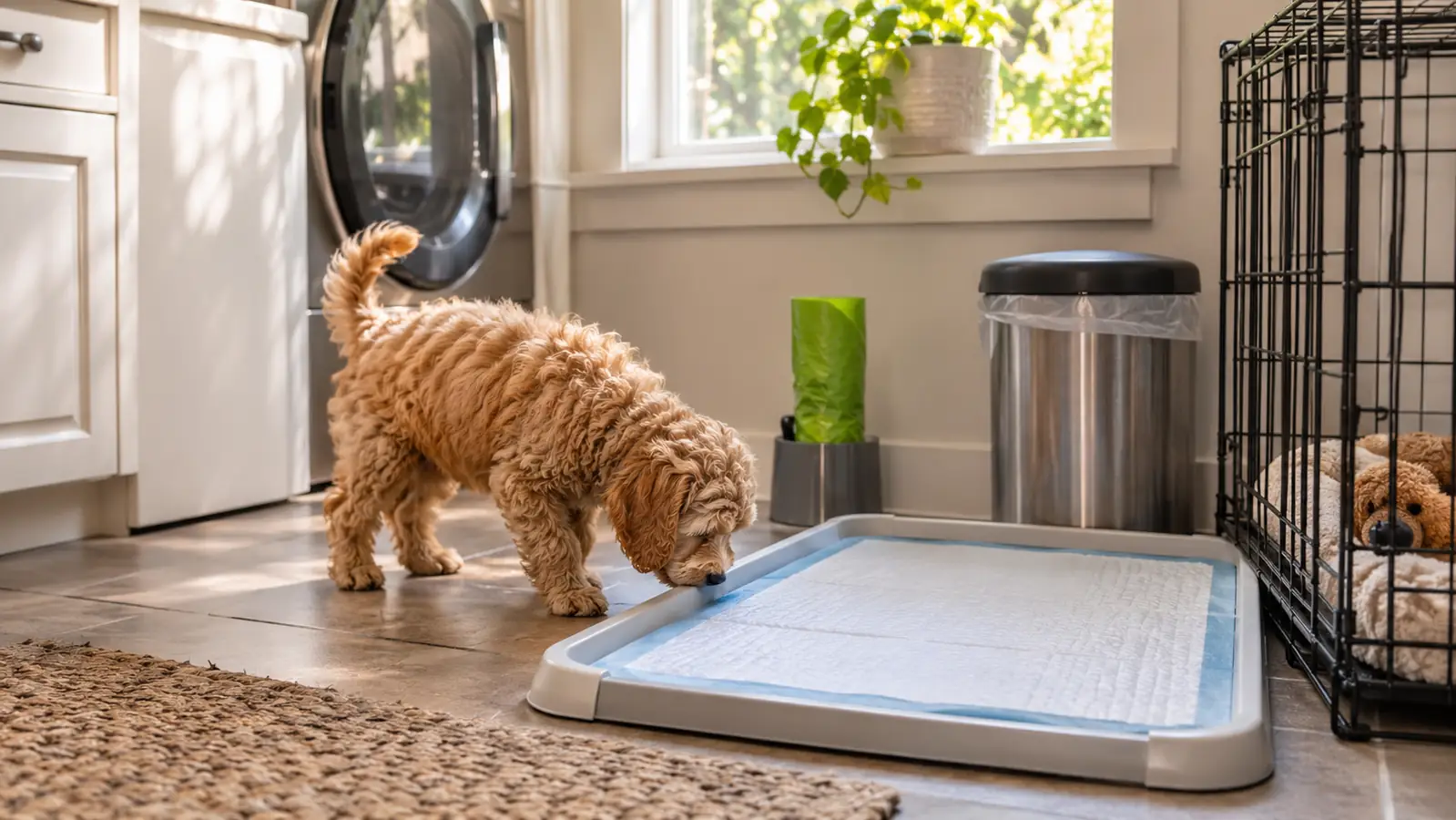
Short answer first: for a puppy under five months old, the Glad pads are the easier buy, and it is not close. I ordered my first box in early April 2026, the week before Clover came home, and four boxes later there is still one on the laundry room floor by the back door. Disposable pads win the two things that matter most in a puppy's first month: speed and smell. Reusable pads are not a bad idea. They are a different tool for a different dog, and I will show you exactly where they beat mine.
Here is the part most comparison posts leave out. I do not own reusable pads. My sister-in-law runs them with her four-year-old dog in Indiana and would not go back, and I have stood in her utility room twice now watching the whole routine. Her dog is housetrained and sleeps through the night. Mine was nine weeks old, six pounds, and going every ninety minutes when I needed something that worked. So this is the view from the person who actually bought the Glad for Pets pads, used them hard for seven months, and can tell you honestly which parts of the cloth-pad argument hold up.
| Glad Puppy Pads | Reusable cloth pads | |
|---|---|---|
| Odor control | Activated carbon in the pad alongside the polymer core; the laundry room stopped smelling | Holds urine in the fabric until wash day, so the smell waits in the bin |
| Absorbency | Listed at under 15 seconds, five layers, up to 12 hours of protection | Wicks slower; a big puddle can sit on the surface for a beat |
| Weekday convenience | Pick it up, fold it, bin it, done in ten seconds | Needs a wash cycle and a dry, plus spare pads in rotation |
| Staying put on a hard floor | Light enough to slide; I ended up using a plastic holder tray | Heavier, and the set my sister-in-law uses has a textured back that grips |
| Value over a long stretch | A 50 count box is gone in weeks | One set washes and reuses for years |
| Trash | Four boxes in seven months is 200 pads into the bin | One set, washed, almost nothing thrown away |
| A puppy that chews the pad | Clover tore a corner twice; the tray stopped it | Tougher to tear, but a chewed edge is fabric, not paper |
| Car and travel | Toss a used one at a rest stop and there is nothing to carry home | A wet pad rides in a bag until you find a machine |
| Best for | Puppies under five months, overnight backup, travel | Adult dogs, seniors, and homes with a fixed routine |
Where Glad Wins
The activated carbon layer is the reason I stayed with these. A pad station in a laundry room with no window, in April, with a nine-week-old puppy going eight or nine times a day, is a smell problem before it is anything else. Glad builds the carbon into the pad alongside the polymer core, and the difference showed up inside a week: that room stopped announcing itself when I walked in from the garage. I change pads twice a day. The room smells like a room, and the trash can is the only thing that ever needs attention.
Then there is speed, which matters more than anyone tells you. The listing says the pad absorbs in under fifteen seconds, that the polymer layer locks the liquid away, and that it keeps a surface dry for up to twelve hours. That tracks with what I saw on a tile floor at 6 a.m. I could lay a fresh pad down, set Clover on it, and go start the coffee. The standard size is 23 by 23 inches, five layers thick, and the listing also shows a Jumbo at 28 by 30. My first 50 count box lasted about five weeks in the heavy weeks.
One more thing nobody mentions: the pad lies flat. My laundry room is tile and the kitchen is hardwood, and a fresh pad goes down smooth the first time without a curl at the corners, which matters more than it sounds when you are doing it one handed at 5:40 in the morning with a puppy under your arm. The five layers are what I think does the work. The polymer pulls the liquid down, the carbon handles the air, and the backing keeps it off the floor. I have picked up a used pad by one corner and never had it drip, and that is the test I actually care about. Between early April and mid July I went through two boxes, and two more have covered backup duty since. I know the count because I stack the empty ones in the garage before I break them down, and that stack is what convinced me this is a real cost and not a rounding error. It still beat the alternative for me, but I am not going to pretend the stack is small.
Where Reusable Pads Win
Value over a long stretch is real and I am not going to argue with it. Fifty pads in a box are gone in weeks. A set of washable pads gets washed and reused for years, and my sister-in-law has run hers through two dogs on the same utility room floor. Prices move, and I am not going to quote hers. But if you are thinking in years instead of weeks, the cloth set is the better value, and that math is not close.
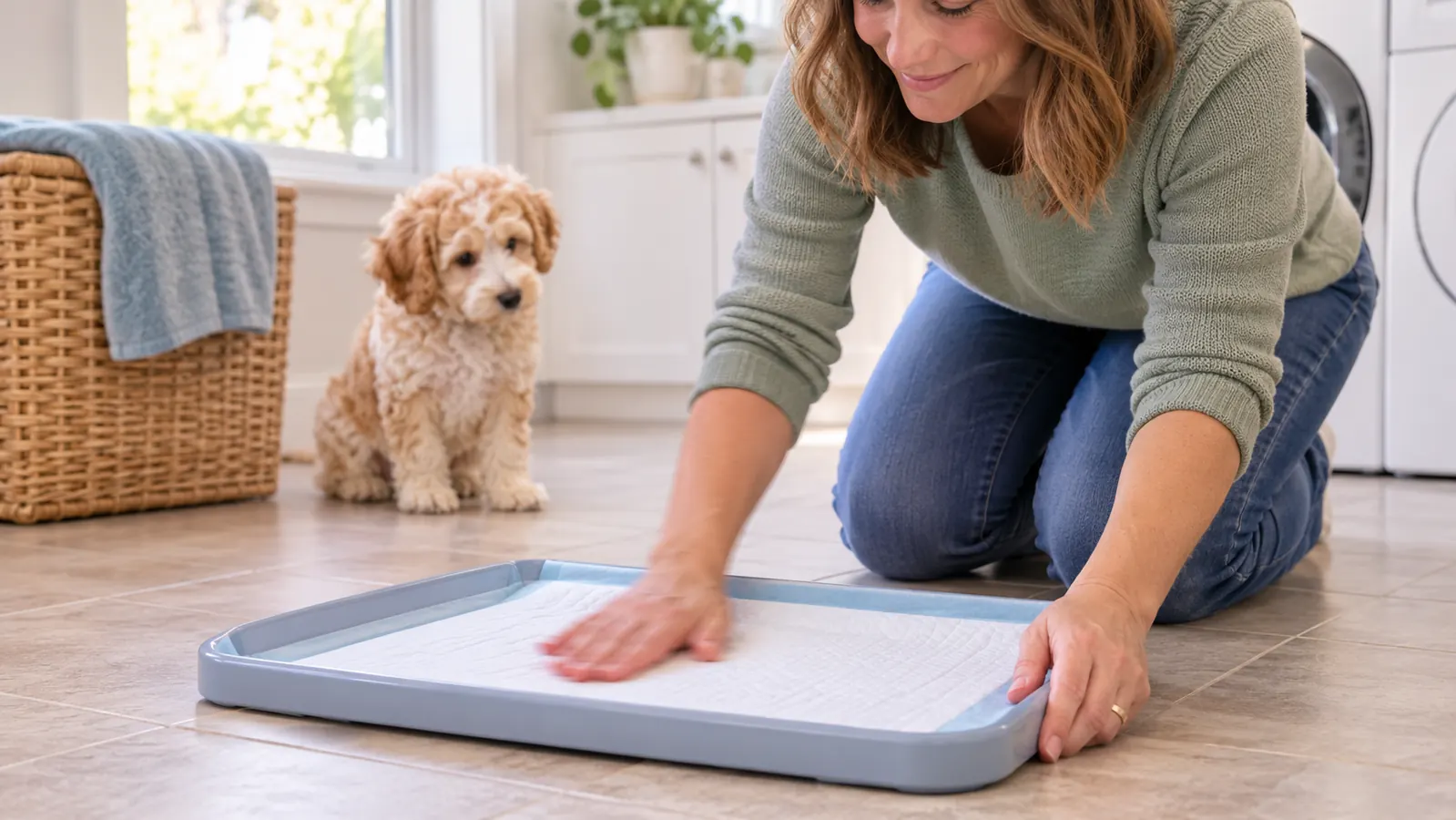
The other thing cloth does better is stay put. A disposable pad is light, and on my hard floor it slides when a puppy skids onto it. I fixed that with a plastic holder tray I already had from a neighbor's yard sale, and after that it never moved. Hers are heavier and the backs are textured, so they grip on their own. Cloth is also the better call for an adult dog left alone through a long workday, or a senior dog who leaks in his sleep, because the pad stays where you put it.
Here is one place cloth has more room to work with. Glad offers the standard 23 by 23 inch and a Jumbo at 28 by 30, and that is the range. Cloth sets come in more sizes than that, so you can match an ex pen footprint or a crate floor more closely. My pads always left a strip of bare tile at the edge, and a wobbly puppy aiming for the border misses it sometimes. That is not a knock on the pad. It is just what happens when you buy in two sizes instead of ten.
Make the 3 a.m. trip a ten-second job
The Glad pad that carried me through the first ten weeks: activated carbon, 23 by 23 inches, 50 to a box. Add a holder tray with the first order and the chewing stops too.
Amazon Check Today's Price on Amazon →What the First Ten Weeks Actually Looked Like
The pad station was four feet from the crate, on the laundry room floor, with a trash can and a roll of bags beside it. In the first two weeks I went through them fast: one in the pen, one by the back door, one in the crate at night. My schedule is four days a week, Monday to Thursday, so Dan took the midday break on the days he worked from home and a neighbor teenager covered the others. Pads are what made that handoff easy. Nobody had to remember which pad was clean or whether the wash had finished.
The first night, Sunday, April 12, I did what a lot of people do and taped a pad to the floor. Clover was nine weeks old and six pounds and had never been in the house, and I wanted that pad exactly where I had put it. By Tuesday one corner had lifted and she had dragged the pad half into the kitchen. That is when the tray came out of the garage and the whole thing stopped being a project. Had I known that on night one I would have skipped two days of re-taping. I also learned to lay the pad down before she was in the room, because a six pound puppy who wants to help is not helping. Ten seconds, done, walk away, then bring her in. That order is the difference between a pad that lies flat and a pad that becomes a toy.
Clover chewed a corner off a pad twice as a young puppy, both times overnight in the crate. The tray stopped it, because the pad sat tucked inside the lip instead of lying loose. If you are bringing home a determined chewer, buy the tray with the first box. A shredded pad is a mess you clean up twice.
There was one 3 a.m. accident in week two where she missed the pad by a foot, and that was on me for putting it down in a hurry. Otherwise the record was good. By mid July she was reliably going outside and the pads moved to backup duty, which is where they still are. One sits by the back door for thunderstorms. One goes in the car crate for the drive to Dan's parents in Indiana. That is not potty training anymore. It is a thing I keep in the house, like paper towels.
The Laundry Question
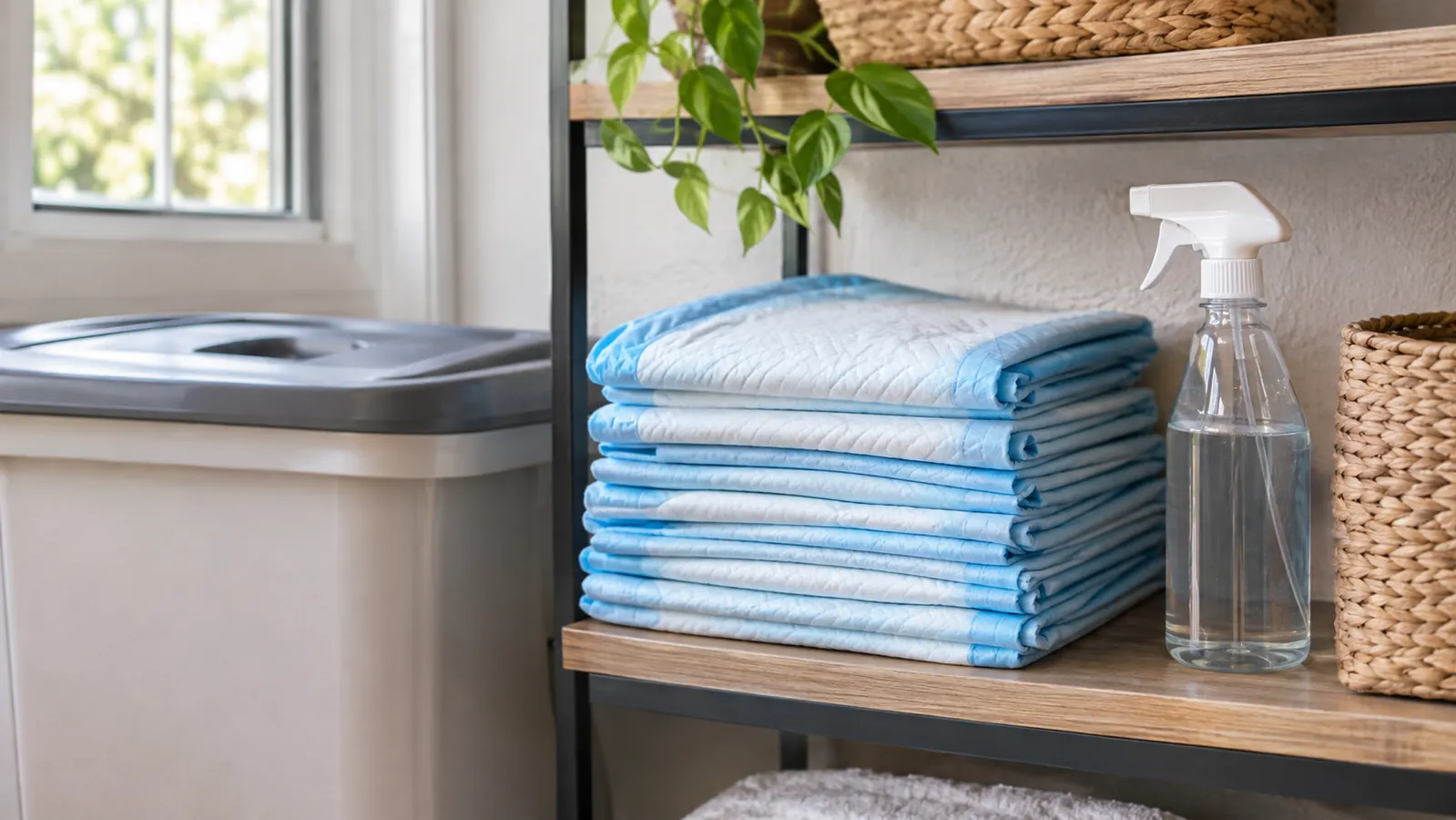
Here is the honest cost of the cloth route, and it is time rather than money. A young puppy produces a startling number of wet pads, and in a washable system every one of them becomes laundry. My sister-in-law runs a load every couple of days and keeps a lidded bin for the dirty ones, and she has the routine down to maybe fifteen minutes of handling a week plus machine time. That is a real number, and it is not nothing.
Her setup, since I have watched it twice now: dirty pads go in a lidded bin in the utility room, lid down, with a scoop of something in the bottom to hold the smell. She runs a load every couple of days on cold with a splash of white vinegar, then hangs the pads over the laundry sink, because the backing does not like a hot dryer. Two years in, she says it is just what she does on Tuesdays and Fridays, the same way I take the trash out. The part I would not have guessed is that the bin is the whole system. If the bin leaks air, the utility room smells like a kennel, and no amount of washing fixes that.
I know how I operate. On a Thursday after eight hours of patients, the ten-second version of a pad change is the one that gets done, and the thing that gets done is the thing that keeps the floor clean. That is the whole case for disposable pads in a first puppy. Cloth is not worse. Cloth asks you for something at 11 p.m., and disposable asks you for a trash bag.
If you do go cloth, the one piece of advice I would pass along from watching her setup is to buy two full sets on day one. One set is in the wash, one is on the floor, and you are never caught with a wet pad and a bare tile. Half a set is how people end up back on disposable pads and calling it a failure.
The carbon layer is the reason the laundry room stopped smelling. Not the absorbency, not the size. A small room with no window and a puppy in it is a smell problem before it is anything else.
Who Should Buy Which
Buy the Glad pads if you have a puppy under five months, if your dog is going out every ninety minutes, if you work outside the home, or if you want a pad in the car and one by the back door without starting a wash cycle. Get the holder tray with the first box. Go Jumbo if your puppy will finish over about 25 pounds, because 23 by 23 inches does not leave much margin for a dog who walks in her sleep, and Clover at 21 pounds is already close to the edge of the standard size.
Buy the reusable set if your dog is already housetrained and the pad is a permanent fixture, if you have a senior dog, if you are home during the day, or if trash volume bothers you. Four boxes in seven months is 200 pads into a landfill, and that number sits with me. If Clover had been a four-year-old dog with a leak instead of a nine-week-old puppy, I would have started on cloth and never looked back.
One more way to choose: look at your floor. On tile or vinyl a light pad slides, so plan on a holder. On carpet, a disposable pad bunches, and a cloth set with a textured back is the more forgiving of the two, though a soaked cloth pad on carpet is its own problem and I would use a tray either way. Neither one survives a dog who chews fabric, and Clover went through a phase that made me grateful I was not washing pads she had put a hole in.
If you are on the fence, count before you commit. Two pads a day for ten weeks is the honest shape of a puppy's first season, and that is a lot of laundry in a washable system. If your number comes out lower than that, which it will for an adult dog, the cloth route is the one that makes sense.
The setup I would buy again for the next puppy
Same order, same size, same tray. Glad for Pets puppy pads with activated carbon, 50 to a box, the one thing in my laundry room that never needed a wash cycle.
Amazon Check Today's Price on Amazon →