
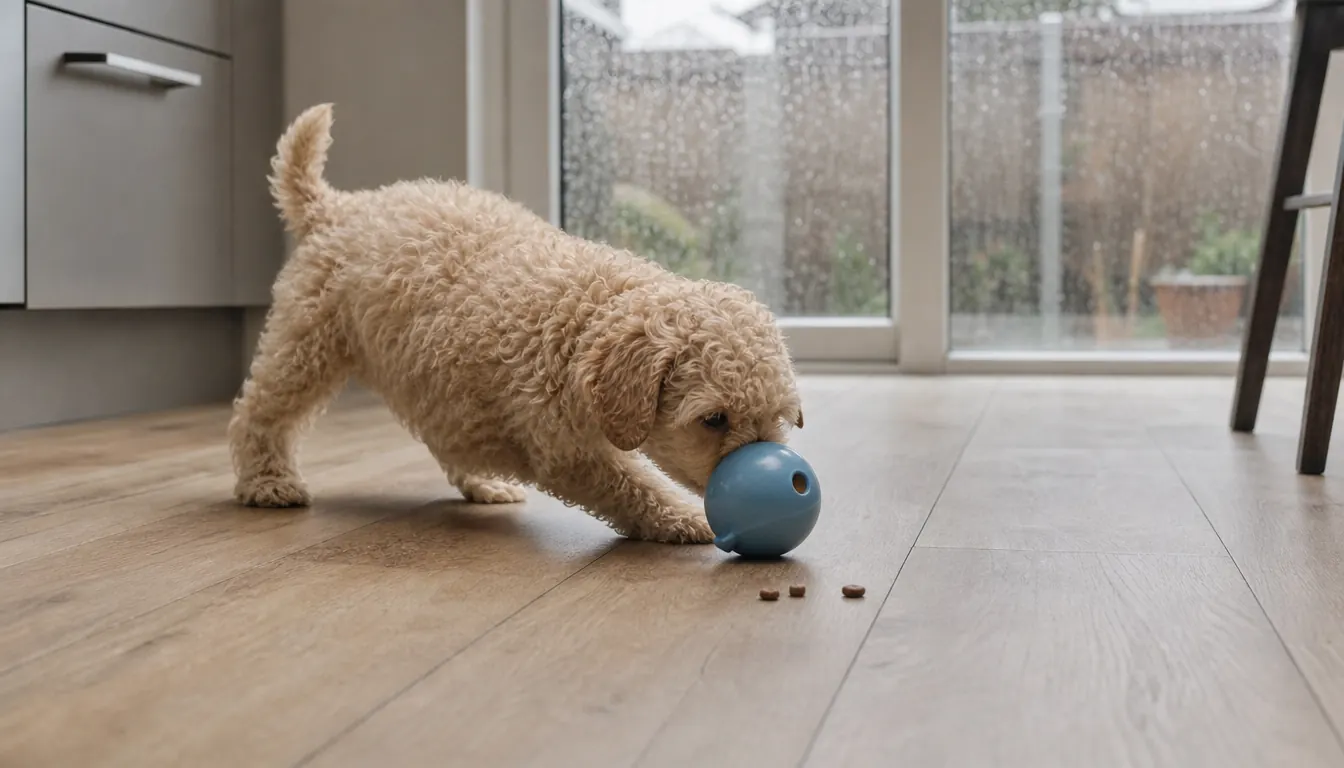
The last week of May it rained five days straight outside Columbus, and my mini goldendoodle, Clover, was about sixteen weeks old. By Wednesday she had chewed the corner of a magazine, dug at the couch cushion, and barked at the refrigerator. She was not being bad. She was bored, and a bored puppy assigns herself a job whether or not you hand her one. Hers was redecorating. That Friday I ordered the Outward Hound Nina Ottosson Treat Tumble, the 4.8 inch puzzle ball, because it was the least expensive thing I could think of that would give her a job with a beginning and an end.
Here is what nobody tells you about a puzzle ball: the ball is not the point. The point is the fifteen minutes your puppy spends working out how breakfast gets out of it. The listing says fifteen minutes of brain work is worth about thirty minutes of running, and after a couple of months of using this thing I believe it. Clover does not trot after it the way she trots after a tennis ball. She stalks it. Her ears go forward, she noses it, she waits, and when a piece of kibble drops she looks personally offended that it worked.
The toy that turned a five day rain delay into a nap schedule
The Outward Hound Nina Ottosson Treat Tumble is a Level 1 beginner puzzle ball built for puppies and small dogs. Mine is the 4.8 inch version, about 4.75 inches across and roughly 5 ounces, and it earns its keep twice a day.
Amazon Check Today's Price on Amazon →Step 1: Match the ball to your puppy, not to the photo
The Outward Hound ball I bought is the small size, listed at 4.75 by 4.75 by 4.75 inches and about 5.29 ounces. That sounds like a minor detail until you watch a young puppy try to work something that is too big for her. A heavy ball gets pushed once and abandoned. This one is light enough that a sixteen week old doodle can send it skittering across the kitchen with her nose, and small enough that she can get her mouth over the opening to check on the goods.
Clover came home at 6 pounds and is about 21 pounds now at seven months, and the small ball still works for her. What I would actually check before you order is your kibble. If your pieces are bigger than the opening, they will jam, and a jammed ball is a dead toy. Ours are small breed kibble, roughly pea sized, and they rattle out at a good pace. If yours are larger, break them up or use a small training treat instead.
Clover was fourteen pounds at her June checkup, and the ball was still the right size for her then. Our kibble measures about a quarter inch across, and I checked one piece against the opening before I filled the ball the first time. If a piece rattles around loose without falling through, it is about right. If it takes a thumb to push it out, it will take your puppy a mouth and a half, and she will quit on it inside a minute.
The listing sizes this for small dogs, and I would take that seriously rather than optimistically. If you have a puppy who is going to finish north of fifty pounds, this is a nose toy that will be under the couch by the second week. It is not a bad toy, it is the wrong size toy, and I would look at the larger puzzle options in the same line before spending anything.
Step 2: Load it with part of a meal, not a bonus snack
The first week I filled the ball with training treats, and Clover got maybe forty extra calories a morning. That showed up at her next weigh in, and the woman at the front desk was polite about it. Now the ball gets her breakfast kibble, measured out exactly as it would have gone into her bowl. She works for food she was going to eat anyway, which is the entire point of a puzzle feeder.
Ours runs on a schedule, because a puzzle at random is just a surprise. I scoop her quarter cup into the ball at 6:40 on weekday mornings while the coffee is going, hand it over on the kitchen floor, and start getting ready. By the time I come back with my shoes on, the ball is empty and she is flat out on the rug. That is a nine minute window most mornings, and I have come to count on it more than I count on the coffee.
How much you put in changes the game more than anything else you can do. Overfill it and everything dumps out in three rolls, and the puzzle is over in ninety seconds. Half full and it takes real effort. I scoop in about a quarter cup, shake it so the pieces settle, and hand it over. It also slows down a gulper better than a bowl ever did, which was a bonus I did not expect when I bought it.
One thing I got wrong early: I mixed a couple of soft training treats in with the kibble. They clumped, jammed the opening, and Clover quit on the ball in about four minutes. Dry, uniform, roughly same-size pieces are what this toy runs on. If you have more than one dog, this is a separate-them toy. Two dogs and one ball is a negotiation, not a puzzle.
Step 3: Show her the first roll, then get out of the way
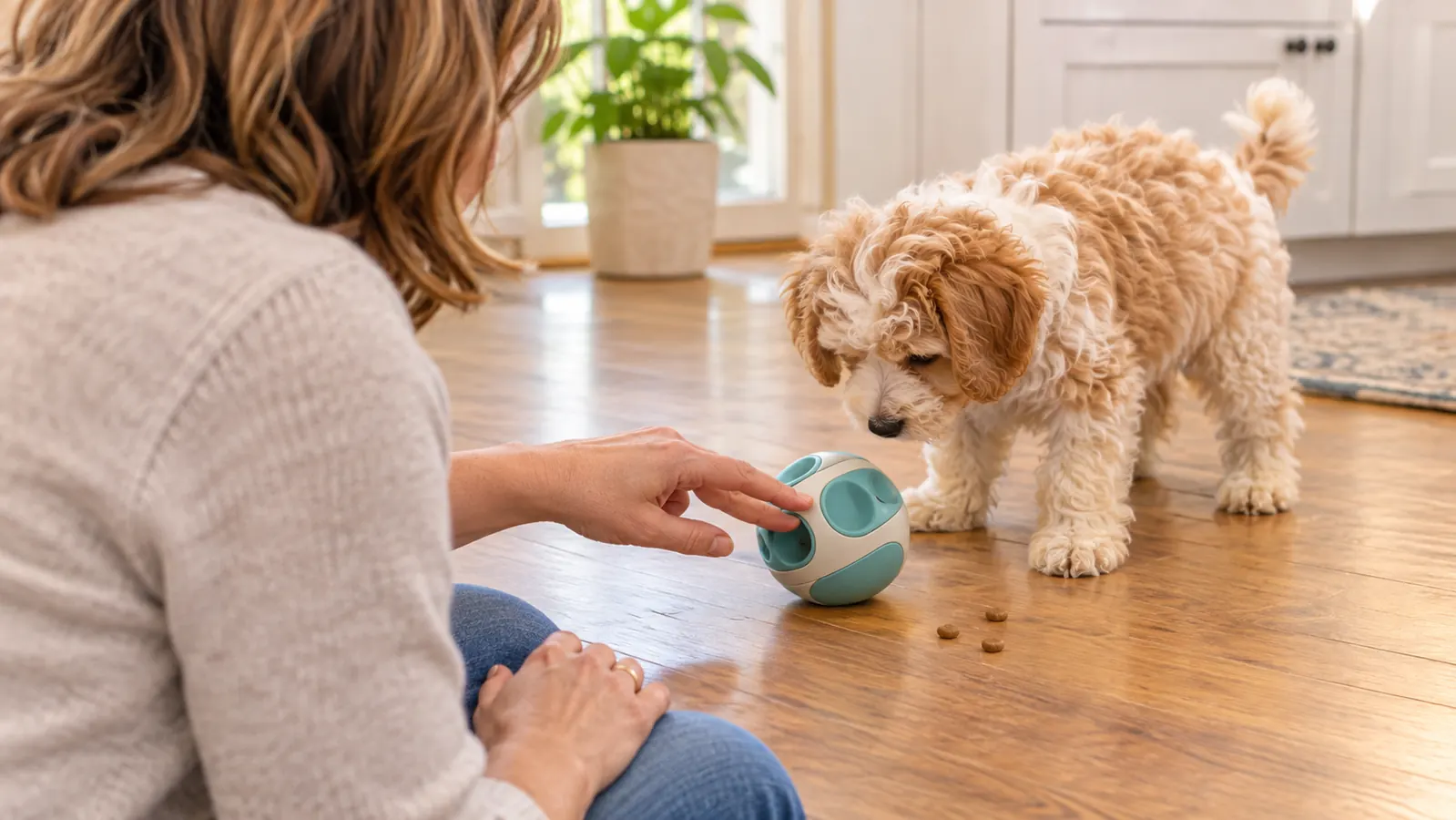
Clover solved it on the first day, which sounds impressive until you see how. I sat on the kitchen floor, put the ball down, and rolled it slowly with two fingers so three pieces of kibble fell out in front of her nose. Then I took my hand away. That was the whole lesson.
What I did not do, and what I would tell you not to do, is hold the ball steady while your puppy noses at it. A puppy who learns you will hold the toy is a puppy who waits for you to hold the toy, and then you have created a chore instead of a game. Let it roll under the chair. Let her be annoyed for a second. The annoyance is the part doing the work.
The only help I give is the stuck ball. Ours wedges under the same chair leg every single time, and if I leave it there Clover stands and stares at me like I cancelled breakfast. I nudge it out with my foot and say nothing at all. No praise, no clapping. The food is the reward. I am just the person who moves furniture.
Fifteen minutes of brain work buys me a thirty minute nap. That trade is the whole reason the ball lives in the kitchen cabinet and not in the toy bin.
Step 4: Use the difficulty adjustment before you decide it is too easy
The Outward Hound Treat Tumble is a Level 1 beginner puzzle, which is the right place to start a puppy and the wrong place to stop. The ball ships with a tips and tricks sheet for adjusting how hard it is. If I had skipped that paper I would have told you by June that the toy was too easy and gone shopping again for no reason.
The tips and tricks sheet lives taped inside the cabinet door now, not in a drawer, because I lost it once for two weeks and spent that time assuming the toy was finished. When I found it and worked through the adjustment it describes, her morning game went from about three minutes to about nine. That was in late June, when she was around four months old and into everything.
The adjustment is small and it is the difference between a thirty second game and a ten minute one. Try the harder setting on a day when you are home and not heading out the door, then watch whether your puppy stays with it. Clover stayed with it. If yours walks away, go back to the easier setting and give it another week. There is no prize for making a puppy quit.
That balance is the whole skill here. Too easy and you have bought an expensive treat dispenser. Too hard and you have bought a paperweight the dog ignores. Level 1 is the correct starting rung for a puppy who has never had to work for food, and most puppies climb a rung within a week or two if you let them.
Step 5: Give it a slot in the day, and take it away when the game changes
The ball works because it is predictable. Ours comes out with breakfast most mornings and again on wet afternoons, and the rest of the time it lives in the cabinet. A toy that sits on the floor is furniture. A toy that appears twice a day is an event, and Clover treats it like one.
Here is the honest part, and it is the one thing I would say to a friend before she orders. This is hard plastic with no give. Around five months Clover started chewing on the ball instead of rolling it, and that is a sound you learn to hate from the next room. When she does it, the ball goes away immediately, not after one more warning. I do not leave it on the floor while I am in the shower.
It is also listed as not water resistant, so I do not dunk it in a sink of water. I shake the crumbs out, wipe the inside with a damp cloth, and let it air dry. That takes about a minute, which is roughly my limit for cleaning anything that gets used twice a day.
The other limit: this is not a walk. Clover still gets her twenty minute loop around the neighborhood in the morning and again after dinner, rain or not, and the ball is what happens between those, not instead of them. A puzzle ball is a twenty minute solution, and I have never gotten more than that out of it.
What Else Helps
What actually fixed that rainy week in May was stacking small things, not finding one hero. The ball for breakfast, a frozen stuffed KONG for crate time, a walk squeezed in between rain bands, and five minutes of brushing on the couch in the evening. None of those is impressive on its own. Together they make a puppy who sleeps through the afternoon instead of eating the magazine rack.
The other thing that helped was a rule a friend gave me: no new toy until the old one is boring. Puppies do not need variety, they need repetition with a little more difficulty on top. Clover still uses the ball she got at the end of May because I keep making the ball slightly harder instead of adding to the toy bin.
The one purchase I would skip entirely is a second puzzle. There is a strong pull, after a wet week, to buy three of them and rotate them like library books. I looked at another one twice in June and did not buy it, and I am glad, because a puppy who gets a new puzzle every seven days never gets properly good at any of them. Buy one, work it up through the adjustments, and only then think about the next.
And if your puppy is chewing furniture, digging at the carpet, or barking at the refrigerator, read it as information rather than a behavior problem. That is a puppy with nothing to do, not a bad dog. If the restlessness comes with changes in eating or sleeping, ask your own vet, because that is well past my pay grade. For plain ordinary bored puppy energy, a toy that pays out breakfast is about the best fix I have found.
Still the first thing I reach for on a wet morning
The Outward Hound Nina Ottosson Treat Tumble is a Level 1 beginner puzzle ball for puppies and small dogs, about 4.75 inches across and roughly 5 ounces. Two months in, it earns its cabinet space twice a day.
Amazon Check Today's Price on Amazon →