
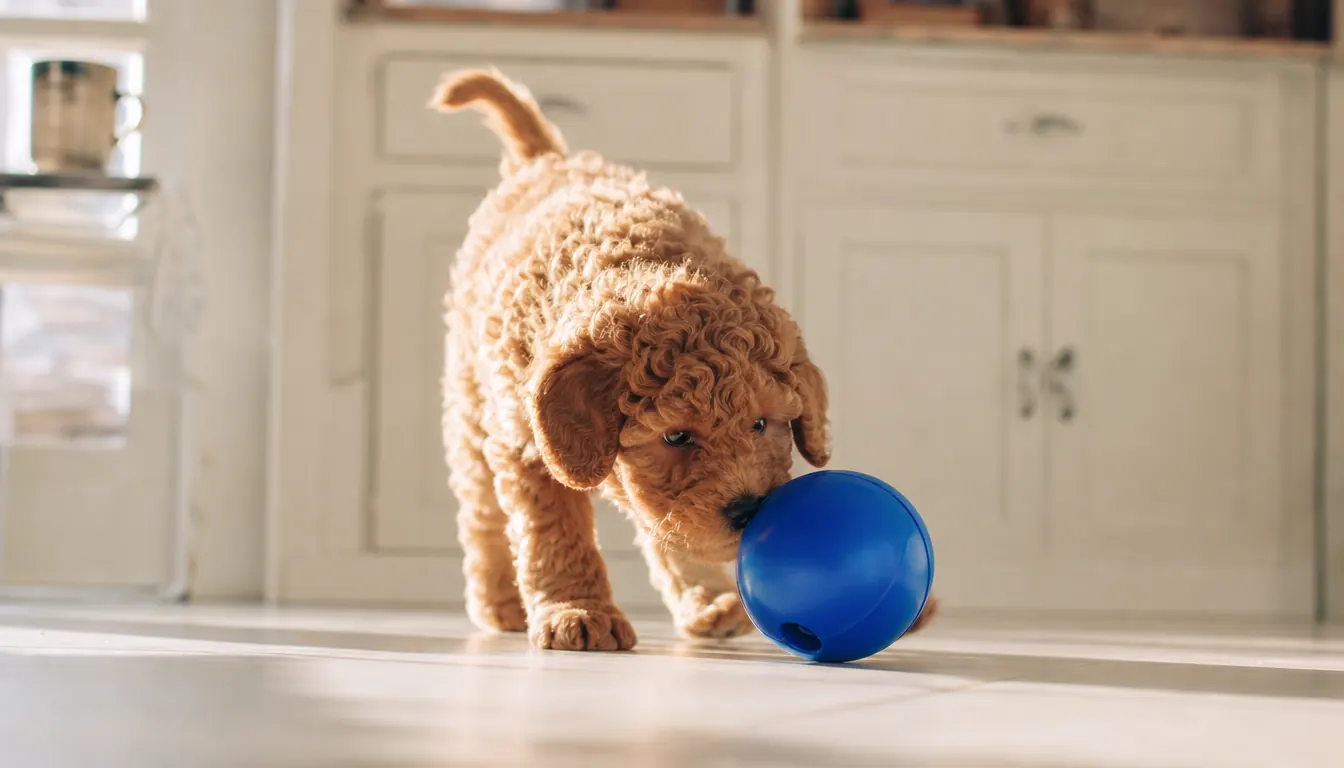
Here is what nobody tells you about a puzzle ball: it does not entertain your puppy. It entertains your puppy for exactly as long as your puppy feels like being entertained, and then it sits on the kitchen tile looking at you like you owe it money. I bought the Outward Hound Nina Ottosson Treat Tumble on May 30, 2026, a Saturday, after four straight days of rain and a puppy who had started barking at the refrigerator. Clover was a little over seven weeks past homecoming then, somewhere around eleven pounds, and climbing the walls in a way that made me feel like the worst puppy parent in central Ohio.
So let me be plain with you, because I read about a hundred reviews before I clicked buy and half of them read like the company wrote them. This ball is good. It is not a babysitter, it is not a chew toy, and it is not something I would hand a determined chewer and then walk out of the room. The one line version: it buys me fifteen quiet minutes at breakfast, it has survived five months of a mouthy mini goldendoodle, and I would buy it again, though not for the reasons the product page gives you.
The Quick Verdict
A genuinely useful first puzzle for meals and rainy days. Not a chew toy, not a sitter, and the hard plastic means it goes on the shelf the moment my dog is done eating.
Amazon Check Today's Price →The ball that got us through a rainy week in May and every breakfast since
Level 1 beginner puzzle, about 4.75 inches across, no batteries and nothing to charge. If you have a small to medium puppy who inhales breakfast in ninety seconds, this is the simplest fix I found.
Amazon Check Today's Price on Amazon →What Nobody Tells You Before You Buy a Treat Ball
The listing calls it a Level 1 beginner puzzle, and that is accurate in a way that cut both ways for us. Clover solved it on day one. Not on day three, not after a week of patient coaching. Day one, in about four minutes, while I was still flipping through the little tips sheet that comes in the box. I had built the thing up in my head as a project the two of us would work on together. It was not a project. It was a snack with extra steps.
That is not a knock on the toy. It is a knock on the way puzzle toys get sold, and I say that as someone who now owns exactly one. A puzzle ball is not a source of entertainment. The food is the entertainment. The ball is the delivery system. The moment the food stops coming, it becomes a plastic object on the floor, and whether your puppy keeps pushing it around depends entirely on whether your puppy enjoys pushing plastic objects around, which mine does for about ninety seconds before she remembers she has a couch to check on.
The other thing I did not expect: the listing's math about fifteen minutes of brain work equaling thirty minutes of running around is not marketing fluff, at least not in this house. On the mornings I fill it, Clover naps afterward in a way she does not nap after a plain bowl of kibble. That was the surprise. I bought it because she was bouncing off the walls during a wet week. I kept it because of the nap.
How I Have Actually Used It
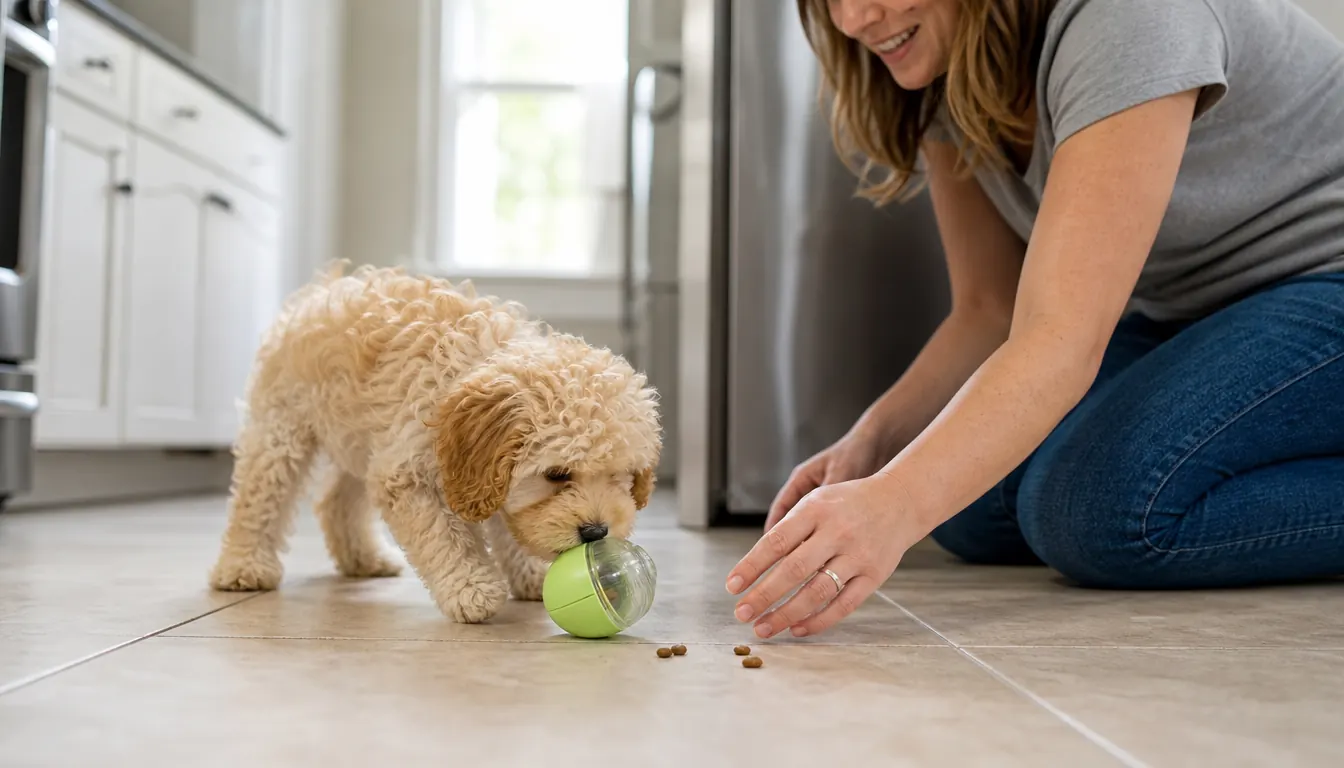
The Treat Tumble is part of breakfast most mornings now. I put a portion of her kibble in, set it on the kitchen tile, and she works for it while I make coffee and get my scrubs on. It measures 4.75 inches across and weighs about 5.29 ounces, so when she knocks it with her nose it rolls instead of skidding, and the kibble drops out in ones and twos rather than all at once. That is the entire mechanism. There is nothing to program, nothing to charge, and nothing that pairs with my phone, which is a large part of why I picked it over the fancier puzzles I looked at.
The second use is weather. Ohio gave us a wet spring and then a wetter stretch in June, and on the days when the twenty minute loop around the neighborhood was not happening, the ball stood between me and a puppy doing laps around the coffee table. I would fill it, she would work at it, and I would get through the last hour before Dan's calls started. He works from home three days a week, so the timing of those calls is not a small detail in our house.
The third use is the one I did not plan for, which is vet morning and groom morning. The ball is lightweight enough to drop in my tote, it does not need batteries, and a dog working at a puzzle in a waiting room is a dog who is not trying to greet every person in the building. I keep a small bag of kibble in the car for exactly this, and the ball lives in the tote now instead of the toy basket.
She solved it in four minutes on day one and she is still knocking it around five months later. That, and the nap afterward, is the whole case for it.
The Honest Downsides, Because There Are Several
Noise is the first one and it is not small. This is a hard plastic ball and my kitchen is tile, so at 6:40 in the morning it sounds like somebody is bowling in the next room. Dan has made his feelings known. On the days he has an early call I fold a bath towel and put it down first, which muffles it enough, but I should not have to think that hard before I have had coffee.
Second, it is not self-entertaining past the food. Clover empties it in about fifteen to twenty minutes, and then she flips it over and starts mouthing the rim, because she is a puppy and a rim is a thing to chew. Hard plastic does not forgive that. So the rule in our house is that the ball goes back on the shelf when she is done and comes out again the next morning. That means its useful window each day is roughly the same as her breakfast, and if you were picturing something your dog plays with all afternoon, this is not that.
Third, the opening suits small kibble. Her food works fine. The bigger training treats I bought for loose leash practice do not, they wedge, and a wedged ball is a boring ball. I now check the size of what I am pouring in, which is a small annoyance that adds up over a month of mornings.
Fourth, and this is the one that matters most to a reader with a big dog: this is a small toy. The listing puts breed size at small, and at four and three quarter inches it is close to the size of a tennis ball with a bit shaved off. Clover is twenty one pounds and it is right for her. A forty pound dog would pick it up and walk off with it, which defeats the rolling entirely, and a dog who swallows something like this is a vet visit I would rather not think about. Ask your own vet about sizing for your dog and use your judgment. Mine is not a large dog, and I am not going to pretend I tested it on one.
What I Got Wrong in the First Month
I filled it to the top the first time. That was a mistake, and it turned a fifteen minute job into a four minute one, because a full ball dumps its contents fast. The tips sheet in the box talks about adjusting difficulty, and the simplest version of that is how much goes in. A third of a portion, maybe half, gets you a slow breakfast. A full ball gets you a floor covered in kibble and a puppy who thinks the game is eating off the tile.
I also left it out overnight twice in that first month. Both times I found it exactly where I would expect to find a hard plastic toy that has been chewed on by a teething puppy, which is to say with fresh tooth marks on the rim. No cracks, luckily. But it taught me that the supervision rule is not a suggestion, it is the entire maintenance plan, and it took two warnings before I actually believed it.
The last thing I got wrong was my own expectations. I thought I was buying a toy. I was really buying two minutes of setup and twenty minutes of quiet. Once I stopped expecting the ball to be interesting after the food was gone, everything about it made sense, and I stopped feeling like I had wasted my money on something she solved too quickly.
How It Has Held Up, and How I Clean It
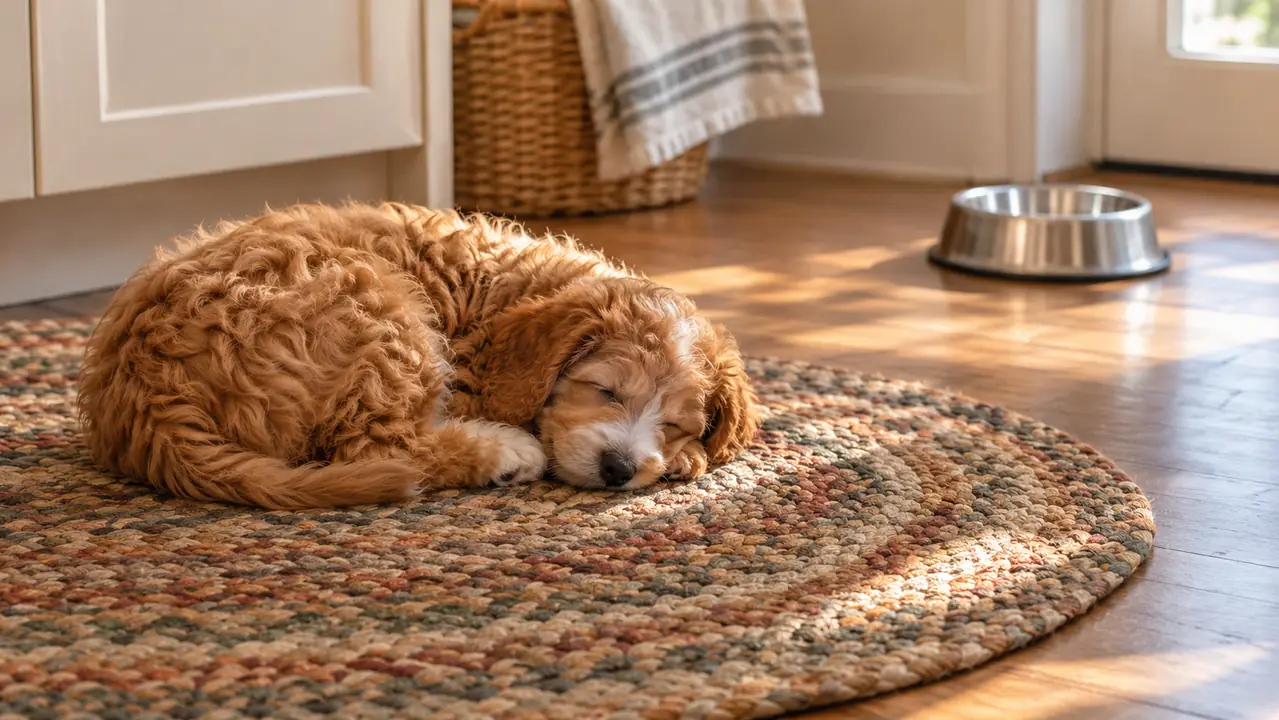
Five months in, the ball has scuffs on the outside from being pushed across tile and a slightly dull finish where her teeth have caught the rim. No cracks, no chips, no loose pieces, and no change in how the kibble comes out. Given what it costs next to everything else in the puppy year, that is fine by me.
Cleaning is a rinse, not a soak. Warm water, a bottle brush I already had in the drawer, then upside down on the rack to dry. The listing says it is not water resistant, and I believe it, because the one time I left it sitting in a bowl of soapy water overnight it came out with water trapped inside and a smell that took two days to leave. I have not repeated that. I would also not put it in the dishwasher. I thought about it and decided I like having a working ball more.
The bigger point about upkeep is that the lifespan of this toy is tied to supervision, not to the plastic. If it lives on the floor, a chewer will eventually work at the seam and then you have a cracked ball and a puppy with a piece of hard plastic in her mouth. Two seconds to put it on the shelf, every single time. That is the whole plan.
What I Liked
- Rolls on tile and hardwood instead of skidding, so the kibble comes out slowly
- Turns a ninety second breakfast into twenty minutes of work
- No batteries, no charging, nothing to pair with a phone
- Rinses clean in under a minute with a bottle brush
- Survived five months of a mouthy puppy with scuffs and no cracks
- Lightweight enough to carry in a tote for vet and groom mornings
Where It Falls Short
- Loud on hard floors at 6:40 in the morning
- Stops being interesting the moment the food runs out
- The opening only suits small kibble
- Hard plastic plus a chewable rim means it cannot be left out
- Too small for large dogs
- Not water resistant, so it needs a rinse and a dry, never a soak
How It Compares to the Other Ball You Are Considering
The comparison most people make is with the KONG Wobbler, and I want to be upfront that I have never owned one. I have stood in the pet store aisle and turned the box over, and I have read enough listings to know the shape of the difference, but I cannot tell you how it behaves in a kitchen because it has never been in mine. What I can tell you is why I chose this one. The Outward Hound ball rolls in every direction. The Wobbler, from everything I have read, is built to be tipped and rocked rather than rolled, which is a different kind of play and a different kind of noise.
If your dog is a hard chewer, the Wobbler is probably the safer pick, because it is sold as something sturdier and this one is plainly not. If your dog is small, food motivated, and new to puzzles, I think the Outward Hound is the better first buy, mostly because a ball that rolls away from a puppy is easier to chase than a base that stays put. Either way, one puzzle toy is enough to start. Do not do what I nearly did and buy three in a single afternoon.
Who This Is For
For a puppy new to puzzles, a small to medium dog, and a household that feeds kibble, this is the right first purchase. Level 1 means Level 1, so the win arrives on day one and you get to watch your dog figure something out without hovering over her. It also suits anyone who is home in the mornings and can keep an eye on things, which I am four days a week.
And it suits people who want one thing that does one job well instead of a shelf of gadgets. I own exactly one puzzle toy. I have not needed a second, partly because the ball still works and partly because Clover has never once looked bored with it. If you already know you have a dog who solves things fast, the Outward Hound puzzle line goes up past this one, and the tips sheet in the box shows ways to make the same ball harder without buying anything else.
Who Should Skip It
Skip it if your dog is a committed chewer who will not leave a hard plastic rim alone. It is not a chew toy and it is not sold as one. Skip it if you have a large dog, or a dog who picks up a ball like this and carries it around, because the whole mechanism depends on rolling. Skip it if you picture yourself filling it and heading out for eight hours. It will be empty in twenty minutes and then it is a chewable plastic object with nobody watching.
Skip it, too, if you need quiet, or if you want a puzzle your dog will still be working on in month three. This one gets solved, and getting solved is the point, but it means the challenge comes from what you put inside it rather than from the design. If that sounds like a letdown, it is a fair reason to look at a Level 2 or 3 instead. I just wanted breakfast to take longer than a breath, and for that it has earned its spot on the shelf.
One ball, fifteen quiet minutes, five months of daily use
About 4.75 inches across, roughly 5.29 ounces, Level 1 beginner. Best for small to medium puppies who eat too fast and need something to do on a rainy afternoon.
Amazon Check Today's Price on Amazon →