

I bought the Coastal Li'l Pals Slicker Brush on May 9, 2026, roughly four weeks after Clover came home from a breeder in Indiana. The reason was not a grooming plan. The reason was that the fur behind her ears had started to felt into small mats I could not pull apart with my fingers, and I panicked a little at the idea that I had already broken my new puppy. I want to be straight with you before you read another word. This brush did not turn Clover into a show dog and it did not make her enjoy being brushed. It is a small, light, plastic-handled brush with flexible wire pins and coated tips, sized at 3.25 by 7.25 inches, and it does one job well. I have used it most evenings for close to six months now, which is long enough to know exactly where it stops helping.
Here is the part I never found in any listing: a slicker brush is not a fix for a neglected coat. It is a maintenance tool. Skip it for three days on a doodle mix and the brush does not undo the damage, it just moves the problem around so it looks tidier for an hour. That took me about a month and one well-timed comment from a groomer to figure out, and it is the most useful thing I can hand you before you spend anything on grooming gear.
The Quick Verdict
An honest little workhorse for puppy coats. It detangles behind the ears and armpits, my puppy tolerates it for about five minutes at a time, and it will not rescue a matted coat no matter how long you stand there.
Amazon Check Today's Price →The small brush that got the mats behind Clover's ears under control
Flexible wire pins with plastic-coated tips, a light plastic handle, and a size built for small breeds and puppies. Check today's price on Amazon before you talk yourself into a whole grooming kit.
Amazon Check Today's Price on Amazon →What Nobody Tells You About a Puppy Coat
Clover is a mini goldendoodle, cream and apricot, about 21 pounds now at roughly seven months old. Her breeder expects 25 to 30 pounds grown. When she came home at nine weeks she had a soft, almost fluffy coat that a washcloth could handle. By week twelve, the coat behind her ears and under her front legs had changed texture entirely. It went from fluffy to something closer to felt in the two spots where fur rubs against fur. Nobody warned me that the tangles show up in the creases first, not on the back where you would naturally brush.
That is the honest case for a slicker brush in a puppy household. The pins are thin enough to get into the crease behind an ear without dragging the whole coat with them. A comb cannot do that. A pin brush with wider, rounded pins tends to skate over the surface of a doodle coat and leave the underlayer alone, which is exactly how a small tangle becomes a big one over a week. The Coastal brush has wire pins with plastic tips, and the tips are the part that matters most for a puppy with sensitive skin. I tested this accidentally. The first time I brushed too fast near her flank she flinched, and I realized I had been pressing. The coated tips did not save me from being careless. They just meant my carelessness did not scratch her.
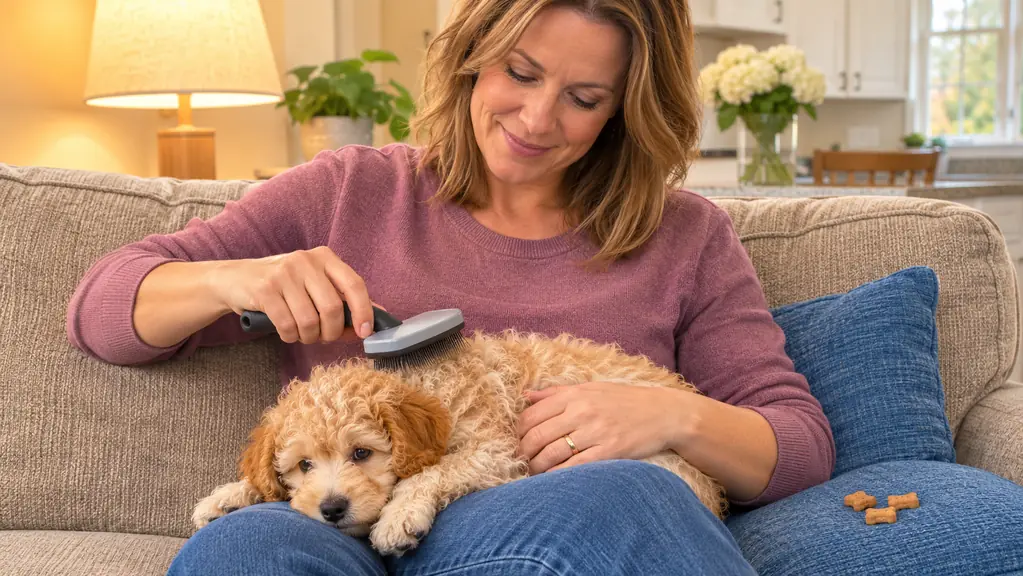
What nobody tells you is that the brush is about a third of the job. The other two thirds are timing and treats. I brush most evenings on the couch, after dinner, when Clover is already half asleep against the cushion. Five minutes is the whole session. If I try for eight, she starts mouthing the handle and we are done. If you are picturing a calm, thorough grooming ritual with a puppy this age, adjust the picture now. It is a short negotiated truce with a spoonful of plain pumpkin or a few training treats as the bribe.
How I Actually Use It, Five Minutes at a Time
The order I do it in has not changed since about June. Ears first, because that is where the tangles live and where I want the most patience left in both of us. Then the chest and shoulders. Then down the back and flanks with long, light strokes in the direction the coat grows. Then the armpits, which is the spot Clover hates, so that comes late and gets the least time. Legs and paws come last and usually get skipped entirely, because she hates her paws being touched and I decided early on that one battle per evening was enough.
The brush is flexible, which sounds like marketing language until you use it on a wiggly puppy. The head gives slightly against the body instead of jabbing when she turns into it, and she turns into it constantly. It weighs under an ounce, so my wrist is not tired after five minutes of short strokes in awkward angles. That sounds like a small thing until you have spent a week brushing a moving target with a heavier brush and found yourself gripping harder than you meant to.
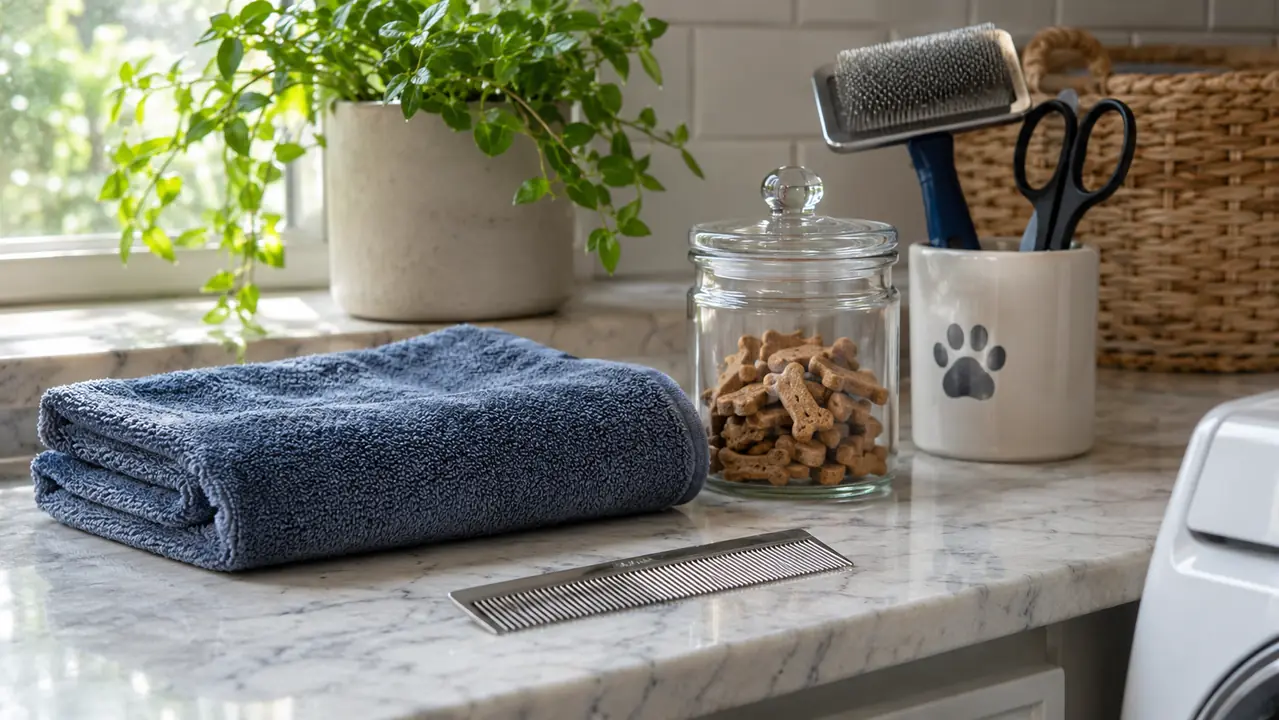
After the brushing I run a cheap steel comb through the same spots, purely as a check. This is the part I would tell any new puppy owner to copy, because the slicker brush can smooth the top of a tangle and leave the knot underneath intact. If the comb glides, we are done. If it catches, I go back in with the brush on that one spot. The comb is not a grooming tool in my house, it is a lie detector.
The Size Question Nobody Answers Straight
At 3.25 by 7.25 inches, this brush is genuinely small. For a nine pound puppy in May, that was perfect. It fit the curve of her shoulder and I could work in tight spots without dragging the whole brush across her body. Six months later, at 21 pounds with a fuller coat, a full-body pass takes noticeably more strokes than it used to. I am not complaining about the brush, because it is doing exactly what a small-breed brush is meant to do. I am telling you that if your puppy is already 20 pounds at four months and heading for 45, this is the wrong size and you will feel it by month three.
The honest fit range, based on what I have actually experienced, is puppies and small breeds up through maybe 25 to 30 pounds of dog. Clover is right at the top of that range and I can feel the ceiling. The listing calls it a brush for small breeds and puppies, and that is accurate rather than modest. Nobody told me that when I ordered, because the listing cannot know how big my dog would get. Clover's breeder could have told me, and I should have asked her.
The head is rectangular, and that shape is more useful than I expected. The corners get behind an ear or into the dip under a front leg in a way a round brush would not. It also means you can work a small area with the tip of the brush instead of the whole face of it, which is how I handle her paws on the rare evenings I try.
The comb is not a grooming tool in my house. It is a lie detector, and it caught three tangles the slicker brush had smoothed right over.
The Parts I Do Not Love
The handle is plastic, and after six months of near-daily use it looks it. No cracks, no loose pins, nothing has failed. But the seam where the two halves of the handle meet has picked up a gray line of grime I cannot get out with a damp cloth, and the plastic has a slightly scuffed look on the side where my thumb sits. For a tool I paid very little for and use constantly, that is fine. If you want something that still looks new in a year, this is not that object.
The bigger honest limitation is that this brush fills with fur fast on a double-coated or doodle coat. Every couple of minutes I have to pull the fur out of the pins with my fingers, and in the fall shed it was closer to every minute. There is no self-cleaning button and no retracting pin mechanism. That is not a flaw in the product, it is what a simple slicker brush is, but if you have watched grooming videos where the pins recess with a push, understand that this is the plainer version and you will be doing that step by hand.
And the last thing, which is not the brush's fault at all: it does not fix a mat. Twice I let the area behind her ears go five days, and twice I found a knot the brush could not touch. Both times I stopped, used my fingers to break the knot apart slowly over a couple of minutes, and then went back in with the brush. If I had kept dragging the brush through it, I would have hurt her and taught her that brushing is a bad thing. That lesson cost me nothing but a little time, and I would rather pass it on than have you learn it in a way that makes your puppy hate the couch.
What I Liked
- The coated tips are genuinely gentle on a puppy with sensitive skin, and my puppy stopped flinching within two weeks
- Small 3.25 by 7.25 inch head fits behind ears, under front legs and into tight creases where a comb cannot reach
- Flexible wire pins give against a wiggly body instead of jabbing when the puppy turns into them
- Under an ounce, so five minutes of short strokes at odd angles does not tire your wrist
- Six months of near-daily use with no bent pins, loose pins or cracked handle
Where It Falls Short
- Fills with fur quickly on a doodle coat and has to be cleared by hand every minute or two during a shed
- Small head means a full-body pass gets slow once your puppy passes about 25 pounds
- Plastic handle picks up grime along the seam that a damp cloth will not lift
- Will not break up an existing mat, so skipped days still cost you time with your fingers
What It Fixed and What It Didn't
What it fixed: the daily felting behind her ears. By mid June I could run the steel comb through that spot without a single catch, and I was brushing four or five evenings a week. Her coat looks smoother overall and the little tufts that used to stick up along her shoulders lie flat. The listing mentions that brushing distributes natural oils, and I cannot verify what is happening under the skin. I can tell you the coat looks less dull than it did in May, and that is the extent of my claim.
What it did not fix: her feelings about her paws. Six months in, she still pulls a front foot back when the brush gets near it. I asked the groomer at Clover's August appointment about it and she said to keep brushing behind the ears and the armpits, which I have done, and to keep paw handling short and separate from brushing. So the brush did its part. The paw problem is a training problem and it is still open.
It also did not replace the groomer. Clover has had one professional groom so far, on August 22, 2026, and the difference between my five minutes on the couch and what that appointment produced was not subtle. If you are buying this to avoid grooming appointments entirely, you will be disappointed. If you are buying it to make those appointments less of an emergency, it does that job.
Who This Is For
This is for the person with a puppy under about 25 pounds, or a small breed adult, who is starting from zero and wants one simple tool that handles the daily creases. It suits a coat that tangles behind the ears and under the legs rather than a coat that mats across the whole back, because a small head and a short session will not keep up with that. It suits someone who will actually use it most evenings. A brush you use twice a month is not worth buying in any brand.
It also suits someone like me, who wants to be told plainly when a tool is not the answer. The Coastal Li'l Pals brush is not going to be the last brush I buy for Clover. I already know I will want something with more surface area as her coat fills in and as she grows toward that 25 to 30 pound estimate. But it was the right first brush, it taught me how to brush, and it is still on the arm of the couch every evening.
Who Should Skip It
Skip it if your puppy is already past 25 pounds or is a large breed headed well beyond that. The small head will cost you twice the strokes and you will be shopping again inside two months. Skip it if you are dealing with existing mats, because this brush is a prevention tool and a mat needs fingers, patience and possibly a groomer. Skip it if you want a self-cleaning brush with retracting pins, since that is a different product and this one will feel like a step backward.
And skip it if the honest answer is that you will not brush regularly. Buying this and using it twice a month is worse than not buying it, because it creates the feeling of having handled grooming while the tangles keep forming behind the ears. That is not a brush problem. I just do not want you to spend anything thinking a tool can stand in for the five minutes.
The Questions I Had Before I Ordered
Will the wire pins hurt my puppy? Not with the plastic tips on them, and not if you use light pressure. I pressed too hard once and she told me immediately. The pins are thin and flexible, the tips are coated, and the failure mode is your hand, not the brush. Go slow for the first week and watch the ears and armpits for a flinch.
Do I need a comb too? Yes, and it can be a cheap one. The comb is how I check whether the brush actually did anything. Five dollars of steel comb saved me from two weeks of thinking I had solved a problem I had only smoothed over. And will it survive a puppy who chews everything? Mine has been chewed on twice and the handle has tooth marks, but nothing has bent or come loose. I still keep it on a shelf rather than on the couch cushion, because a determined chewer with a plastic handle is a bad combination and I only needed to learn that once.
Start with the small brush, not the whole grooming aisle
One job, done每天晚上 for five minutes. Coated wire pins, a light plastic handle, and a 3.25 by 7.25 inch head that fits the creases a comb cannot reach. Check today's price on Amazon, then go find out where your puppy hides her tangles.
Amazon Check Today's Price on Amazon →Six months in, this is where I land. The Coastal Li'l Pals Slicker Brush is the tool I reach for almost every evening, it cost me very little, and it has held up to daily use without a single bent pin. It is not the last brush Clover will own and it was never going to be. If you have a small puppy, a coat that tangles in the creases, and five honest minutes a night, it is a sensible place to start. If you have a big dog, a matted coat, or no intention of brushing regularly, put it back and ask your own groomer what fits your dog instead.