
The first thing nobody tells you about Glad for Pets Puppy Pads is that one box is not a purchase. It is a starter kit. I ordered my first 50 count in early April 2026, the week before Clover, my mini goldendoodle, came home, and I have bought four boxes since. That is roughly two hundred pads, most of them laid flat on the laundry room floor during the first ten weeks. Nobody warned me about the arithmetic, so consider this the warning.
Here is what this is not. It is not a page that tells you the Glad pads are perfect, because they are not, and a 4.4 star average across more than 110,000 ratings already hints that plenty of people found something to pick at. What they are is the box I kept reordering without thinking about it, which is a different and more useful thing. If you are scrolling a listing at eleven at night with a puppy asleep two feet away, this is the version I wish someone had handed me in April.
I am not a trainer and I am not a vet tech. I am a dental hygienist outside Columbus who works four days a week and had exactly one puppy to figure this out on. Clover is my first dog as an adult, and I made most of the obvious mistakes in the first month, including the big one with the crate that I will get to. So this is not expert advice. It is a set of notes from someone who already spent the money.
The Quick Verdict
The pad I kept buying again: fast absorption, a carbon layer that genuinely killed the laundry room smell, and a 23 x 23 inch size that fits a puppy and not much more.
Amazon Check Today's Price →The laundry room stopped smelling like a kennel by week two
The activated carbon layer sits under the surface and goes after the smell, not just the wet. Fifty pads, five layers, 23 x 23 inches each, which is the Standard size for puppies and small dogs.
Amazon Check Today's Price on Amazon →How I've Actually Used Them
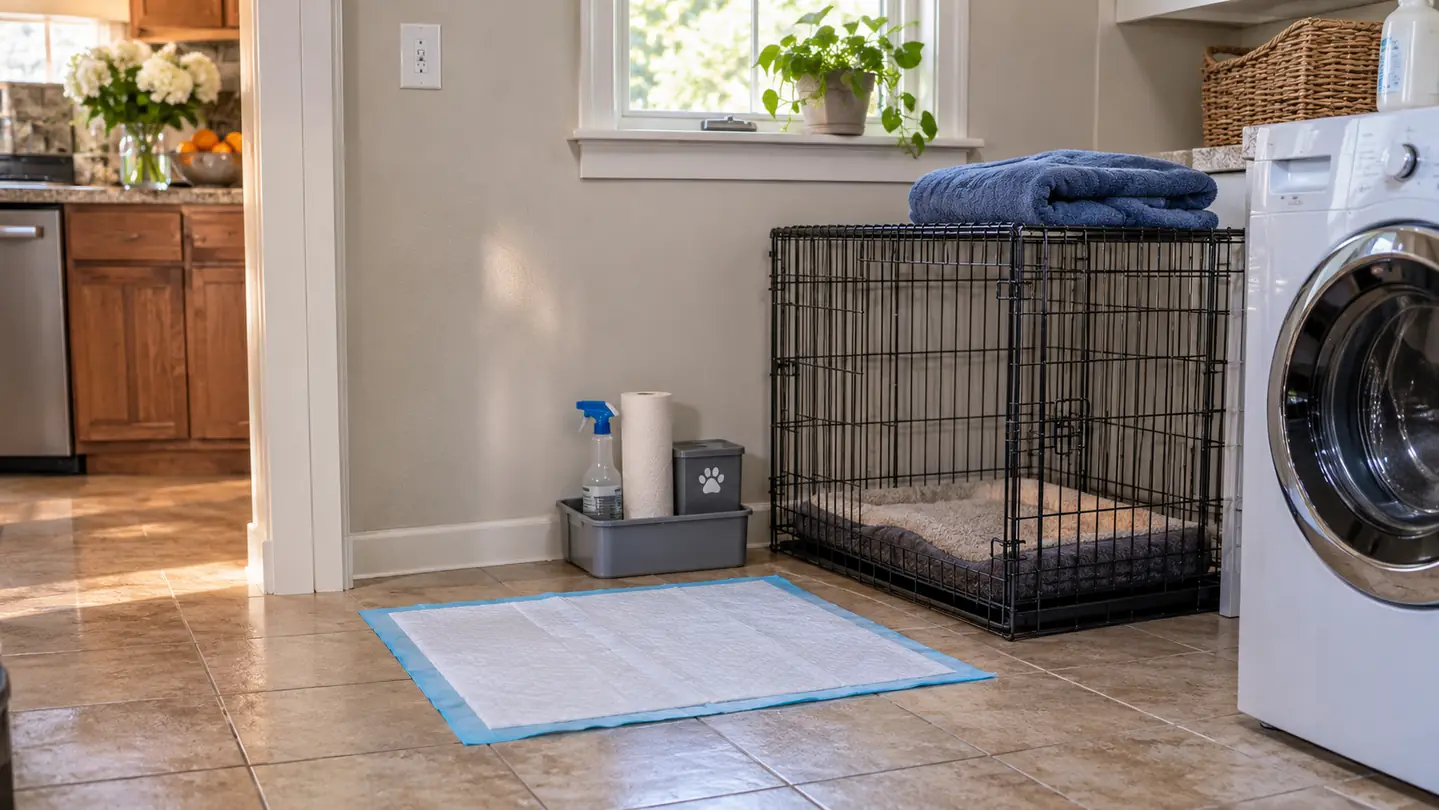
The first night she was home, I put a pad inside the crate, which turned out to be the wrong move, and one outside it, which was the right one. A puppy with a pad in the crate learns that the crate is a bathroom. Mine went on the floor beside it, the crate stayed bedding only, and every accident that first week landed exactly where I wanted it to land.
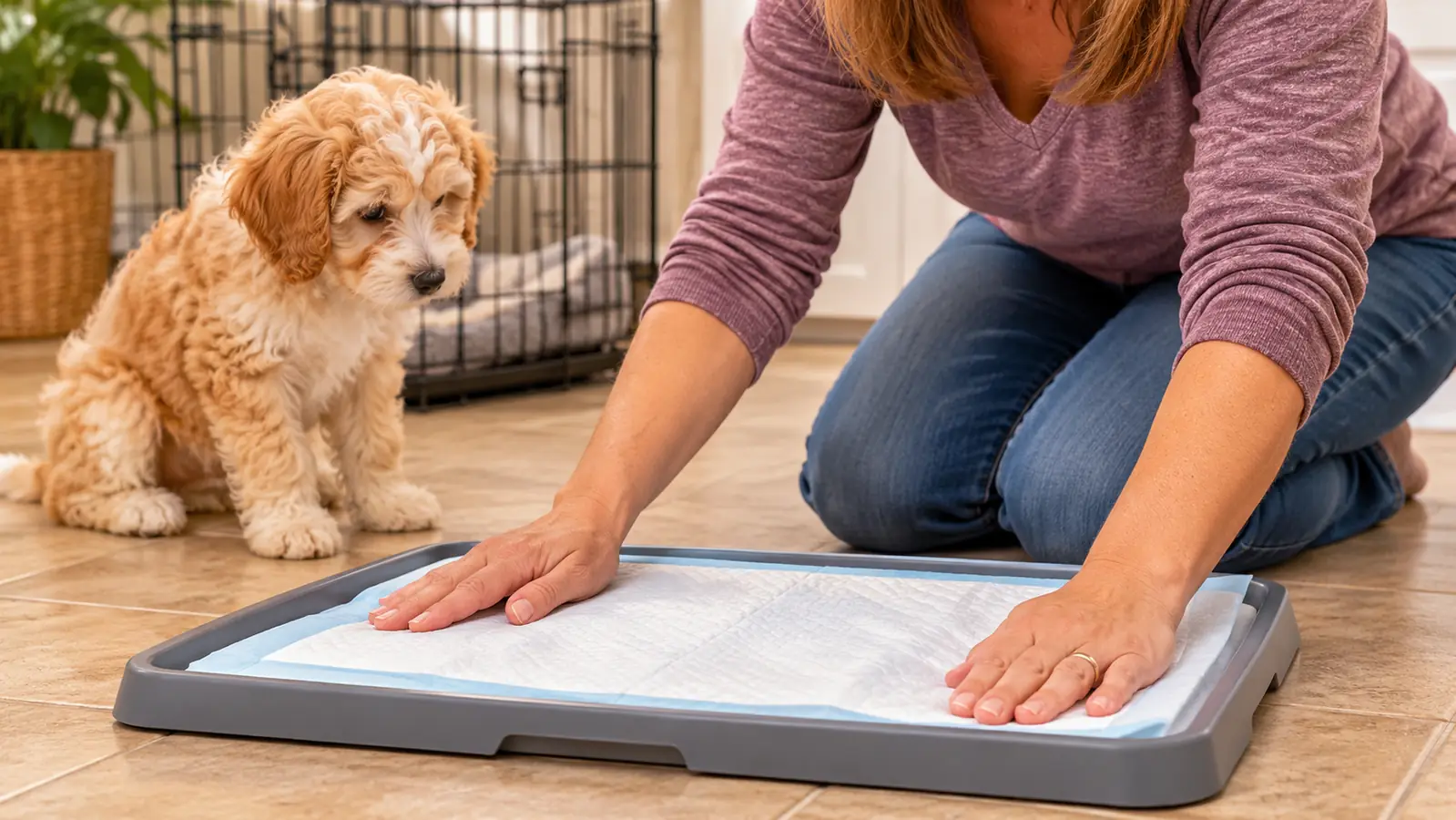
The setup is not elaborate. The crate sits in the laundry room off the kitchen, and one pad goes flat on the floor beside it, tucked into a plastic holder tray I picked up at a neighbor's yard sale. That tray is the only pad accessory I own. For the first ten weeks, Clover used the pad overnight and between midday visits from a teenager down the street, and it caught what our schedule missed on the days I left for the office before seven.
What I actually cared about at three in the morning in late April, half asleep and holding a six pound puppy, was whether the liquid stayed where it landed. It did. The polymer layer pulls it down and holds it, and the surface stayed dry enough underfoot that she would walk back onto the same square an hour later instead of circling a wet patch and choosing the rug instead.
There is a rhythm to how you use these that nobody explains in the listing. You put one down at bedtime, you take it up in the morning, and you do not leave it out all day once your puppy starts to get the idea, because a pad that is always available is a pad that always gets used. Mine lived in a stack next to the crate and came out when the schedule needed help, which for us was overnight and the hours I was at the office.
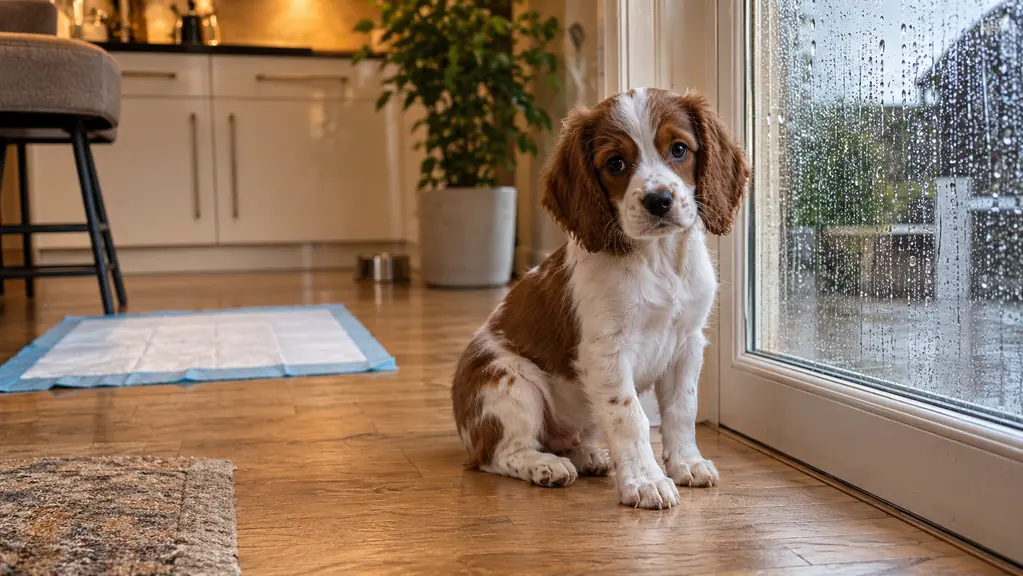
By mid July 2026 she was reliably going outside, which is the outcome you are paying for. Since then the pads do a smaller job. One sits by the back door overnight, one goes in her car crate for the long drive to my in-laws in Indiana, and one comes out during thunderstorms, because a seven month old doodle who already dislikes thunder is not going to ask politely to go out in it.
What the Listing Gets Right, Which Is Rarer Than It Sounds
Most pad listings oversell. These do not, and I checked the claims against my own floor. Five layers, which you notice the moment you pick a wet pad up by a dry corner and it holds together instead of dripping on your shoe. An ultra absorbent polymer layer that the listing says absorbs in under 15 seconds, which matches what I saw, though I was not standing there with a stopwatch. And the detail that sold me: activated carbon.
The carbon is the reason I bought Glad instead of the plain pads my sister-in-law keeps in her pantry. Odor is what makes a pad station unbearable, not the wet. For two weeks in April the laundry room smelled like a pet store, and then it stopped. I did not change the trash routine, the floor or the crate. A carbon layer does work that a plain pad cannot do, and it is why I stopped bracing myself every time I walked past that door.
It helps to know what carbon is doing, since it is the word on the front of the box. It traps odor molecules rather than covering them with a scent, so it works on what is rising off the pad all night instead of for ten minutes after you open the bag. A closed laundry room with the door shut is the harshest version of that test, and these passed it.
I have changed a plain pad at my sister-in-law's house and I know what a station smells like by day three. These do not get there. They are not scentless after a full night and I would not pretend otherwise, but the room reads as clean when you walk in, and the smell no longer climbs the stairs the way it did in April. That single difference is most of why the Glad box stayed on my reorder list while other puppy purchases did not.
For two weeks in April the laundry room smelled like a pet store, and then it stopped. I did not change the trash routine, the floor or the crate.
The 23 Inch Question Nobody Asks First
Each pad measures 23 x 23 inches. The listing says plainly that this is the Standard size, best for puppies and small dogs, and that Glad also makes a Jumbo at 28 x 30 inches for anyone who needs more room. I read that sentence, nodded, and did not think about it again, because Clover was six pounds at the time and a 23 inch square looked enormous next to her.
At about 21 pounds and seven months, she still fits on one comfortably, but the margin is thinner than it was in April. A puppy who drifts while she sniffs will put a back paw off the edge, which is fine on tile and less fine on carpet. If you have a retriever mix or anything headed past 30 pounds, buy the Jumbo and do not be clever about it. For a small breed or a doodle in this range, the standard square is right and the Jumbo would just be wasted floor.
Mine sits on tile, which is forgiving. If your pad station is on carpet, the size question matters more, because a back paw off the edge is a stain instead of a wipe, and that is an argument for the holder tray as much as for the Jumbo. Either way, measure the spot before you order. A 23 inch square plus a tray needs a little more than 23 inches of clear floor.
The listing also promises up to 12 hours of protection, and 12 hours is a real number in a puppy's life. It is roughly the gap between the last trip outside at ten at night and the first one at six in the morning. I never came downstairs to a pad that had gone through to the tile, and I was checking, because I knew exactly what a puddle under the crate would cost me in mopping. Where it gives out is capacity, not time. A puppy who drinks a lot and goes twice on one square in a night will test the edges, and that is a second pad problem rather than a product problem.
One more thing about size, since it caught me. A 50 count box of 23 inch pads is a modest stack when it is still wrapped and a much bigger deal when it is open in your laundry room, because it takes up real space on a shelf. Mine live in a basket under the folding counter with the dog towels stacked on top. If your space is tight, know that you are storing a small bale of pads, not a book.
Three Things That Bugged Me
The pads slide. On a hard laundry room floor, a puppy who launches herself at one will push it an inch or two, and once it bunches the aim gets worse. The holder tray fixed it completely, but the tray was not in the box, and nobody mentions that you will probably want one. This is not a flaw in the Glad pad specifically. It is true of every flat pad I have handled, and it is still the first thing I would fix.
They are shreddable. Clover got a corner of a pad into her mouth twice as a young puppy, both times in the first month, both times while I was in the next room. It was not a disaster and it was not a vet visit. It was a reminder that a pad on the floor is an object in a puppy's world, and that a bored puppy with a loose edge will test it. The tray helped here too, because a pad tucked into it has no loose edge to grab.
And they are disposable, which is the entire point and also the ongoing cost. Four boxes in seven months is a real line item, and it does not stop until your dog is trained. I have looked at washable pads at my sister-in-law's and I understand the appeal, but a wet cloth pad sitting in a laundry basket for two days in July is not something I wanted in my house. That is a preference, not a verdict, and I would not argue with anyone who chose the other way.
The other thing nobody mentions is the trash. A wet pad is heavier than a dry one and it has to go somewhere. Mine go into a small lidded can in the laundry room, emptied every other day, which is a chore that did not exist in my life before April. That is not a flaw in the pad. It is the half of pad ownership the listing does not show, and if your trash goes out once a week, plan for the smell to win before the pad does.
Last complaint, and it is a small one. The pads arrive compressed, and the first one out of a new box has a crease down the middle that does not lie flat until you smooth it out with your hand. It takes ten seconds. It is not a defect, and I mention it only because I stood there on night one wondering whether I had bought the wrong thing. Smooth it, tuck it in the tray, and it behaves.
What I Liked
- Absorbs fast enough that the surface stays dry, so a puppy keeps using the same spot instead of finding carpet
- Activated carbon layer cut the laundry room odor within about two weeks and held it down overnight
- Five layers hold together when you pick a wet pad up by one dry corner
- 23 x 23 inch square fits a puppy or a small dog, with a Jumbo at 28 x 30 inches for bigger dogs
- Fifty pads per box gets you through the first stretch without a panic reorder
Where It Falls Short
- No grip, so pads slide and bunch on a hard floor without a holder tray
- Loose edges are easy for a teething puppy to grab, and a corner can go in seconds
- The standard 23 x 23 size runs out of room for a dog headed past about 30 pounds
- Disposable means a steady repurchase, and four boxes in seven months adds up
- Wet pads have to be bagged and taken out often, which is a chore nobody warns you about
What I'd Do Differently If I Started Over
Buy the holder tray on day one. Not more pads, the tray. A pad that stays flat absorbs better, smells less and cannot be dragged into a corner, and the difference between a pad on bare tile and a pad in a tray is bigger than the difference between these pads and a cheaper box. I got mine for next to nothing at a yard sale and it did more for my training setup than anything else in that room.
Buy two boxes up front instead of one. Fifty pads sounds like a lot until you are changing one at six in the morning and another at eleven at night, and then it is about ten days. Running out mid week during training is the kind of small crisis that makes people abandon a routine that was working.
Do not leave a pad down all day once your puppy starts getting the idea. I did that for about a week in June, mostly out of caution, and it slowed us down. A puppy with a pad available will use it. The Glad pads work best as a bridge and a backup, not as permanent flooring, and treating them that way is what got us to a dog who asks at the back door.
The last thing is scheduling. I set two alarms on my phone for the first month, one at ten at night and one at six, and the pads did the rest. A pad is not a substitute for taking your puppy out. It is what keeps the floor dry when you are twenty minutes late, and if you treat it as the plan rather than the safety net, you end up with a dog who is still using one at a year old.
If I had it to do again with another puppy tomorrow, I would order the same Glad box, add the tray, and set the same two alarms. That is not a dramatic endorsement. It is the honest version, from someone who has mopped less in the last seven months than she expected to, and who still keeps two pads in the laundry room in case the thunder comes through.
Who This Is For
This is for the person with a puppy under about 25 pounds, or a small adult dog, who wants one pad station that does not stink and does not need to be laundered. It suits a first time puppy owner who is crate training and needs overnight backup more than a permanent indoor bathroom. It also suits anyone in a cold climate or an apartment, where getting a small dog outside every two hours in February is not a realistic plan, and a senior small dog who cannot always hold it until you get home.
It also suits the person who has already tried a cheap box and given up on the smell, because that is the specific problem the carbon layer solves. If your current pad station makes you hold your breath when you walk past the laundry room, this is the fix, and it is a fix that keeps working past the first week rather than fading after the bag is open.
Who Should Skip It
Skip these if you have a large breed puppy. A 23 inch square will not hold a retriever or a shepherd puppy, and buying two pads to cover one spot doubles your cost for a worse result, so go straight to the Jumbo. Skip them if you already know you want washable pads and you have a laundry setup that can handle them, because switching later means paying for both systems. And skip them if your puppy is a dedicated edge chewer who has already gone through a bed, since a pad is easier to destroy than a bed is.
One honest note for anyone with a dog who is already house trained. You do not need these. A single pad by the back door for storms is a reasonable thing to keep, but a 50 count box would sit in your closet for two years and dry out at the edges. Buy the smallest pack that covers your actual use, or skip it and put the money into a better crate mat.
And if your puppy is having accidents that seem unusual, or is going far more often than a puppy should, that is a conversation for your vet and not a shopping problem. I say that as someone who spent one long weekend reading pad listings instead of making a phone call, which was the wrong order of operations.
Four boxes later, this is still the pad by my back door
Activated carbon, five layers, 50 pads at 23 x 23 inches each. Order the holder tray the same day and you will skip the two weeks I spent chasing a sliding pad around the floor.
Amazon Check Today's Price on Amazon →