
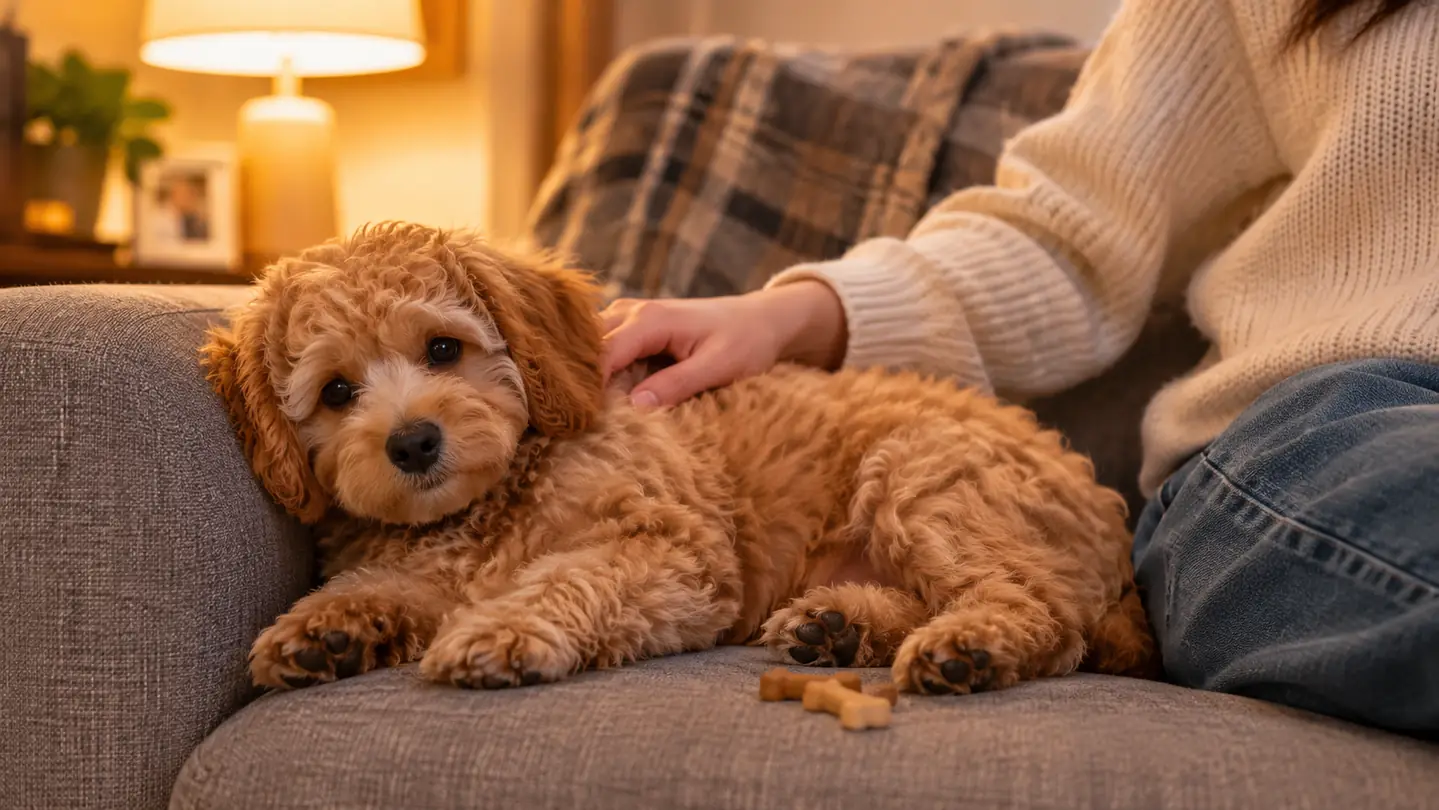
Clover came home on April 12 and I had a brush before she had a name tag. Buying it was the easy part. The hard part was the first evening in early May, when I sat down on the couch with a puppy small enough to fit in the crook of my arm and about eleven seconds of cooperation. She wiggled. She rolled. She tried to eat the pins. I ended up with a brush full of fuzz and a puppy who had decided the couch cushion was a wrestling mat. The brush was the Coastal Pet Li'l Pals Slicker Brush, a small rectangular slicker I bought on May 9, when the coat behind her ears started to tangle. It took me about two weeks to learn how to use it on a moving target. Here is what actually worked.
A puppy coat is not a grown coat. Clover is a mini goldendoodle, seven months old now and about 21 pounds, and somewhere around four months her coat stopped being fluff and started matting if you looked at it wrong. Behind the ears first, then the armpits. Before the Coastal brush, my method was my fingers and hope. The brush itself is plain: flexible wire pins set in a plastic handle, a plastic tip on each pin, 3.25 by 7.25 inches overall. It has one job and it does it. The part nobody warns you about is that the brush is not the skill. The skill is getting a wiggly puppy to hold still for five minutes, and that is a training problem wearing a grooming hat.
The Brush That Fits One Hand While the Other One Holds the Puppy
The Coastal Li'l Pals Slicker Brush is 3.25 by 7.25 inches, with a plastic handle and flexible wire pins tipped in plastic, sized for small breeds and puppies. It is the brush I reach for every evening on the left end of the couch.
Amazon Check Today's Price on Amazon →The Five Minute Routine That Works on a Moving Puppy
The routine below is the one I use on Clover most evenings. It takes five minutes, it assumes the puppy would rather be doing anything else, and it beats everything I tried on my own during those first two weeks.
Step 1: Set Everything Down Before the Puppy Is on Your Lap
My first mistake was brushing on the floor in the middle of the living room, which is where Clover plays. Wrong room, wrong energy. She has one spot where she reliably settles: the left end of the couch, against the arm, in the evening after her walk. Same cushion, same time, almost every night. I brush there and nowhere else. If I try it in the kitchen she is up and down like a jack in the box, and I get about four passes before we both quit.
The other half of the setup is having everything within reach before you start, because the second you stand up the puppy is gone. Brush in one hand. Small treats on the cushion by my hip. The steel comb I use to check my work, also within reach. Three things, and none of them are worth standing up for mid-session. I learned that the night I left the treats on the counter and spent the rest of the session watching her follow my hand instead of holding still.
Treats matter more than you would think at this stage. I break one small treat into four or five pieces and hand them out one at a time. A whole treat disappears in a second and buys you nothing. A quarter of a treat buys a full pass over the shoulder. The Coastal brush is small enough to hold in my right hand while I feed with my left, no switching, no fumbling. That sounds like nothing. With a wiggly puppy it is the difference between a finished brushing and a dog on the floor.
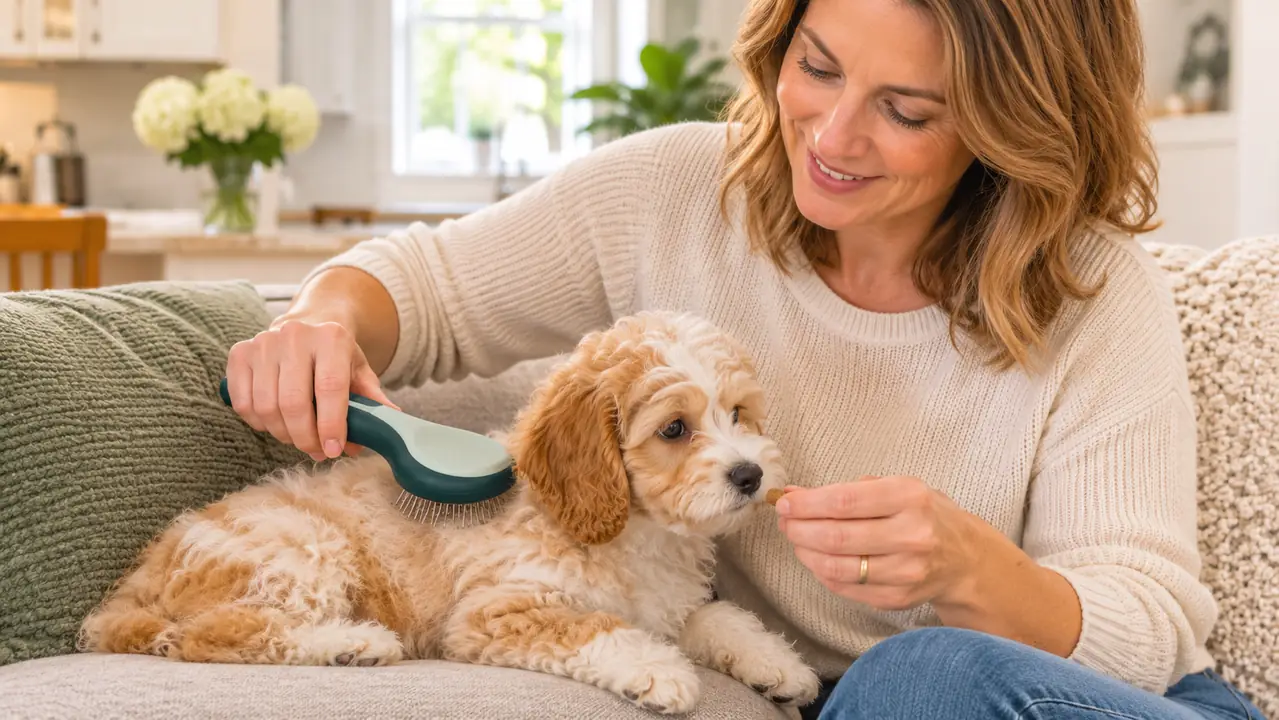
Step 2: Start Where She Is Calm, Not Where the Tangle Is
The instinct is to go straight for the mat behind the ear, because that is the reason you bought a brush in the first place. Resist it. If the first thing your puppy feels is a pin working through a knot in a sensitive spot, she learns that brushing hurts, and she brings that lesson to every night after. Start on the shoulder or the middle of the back, where the coat is loose and the skin is not thin. You are building a habit, not fixing a mat.
The pins are what make this possible. They are wire, but each one ends in a plastic tip, so the first contact is a smooth rounded end instead of a scratch. On a puppy who has never been brushed, that first sensation is the whole negotiation. Clover's shoulders were fine from day one. Her ears took a month, and I do not think any brush on the market would have shortened that. It was a trust timeline, not an equipment problem.
Thirty seconds on the easy part is plenty for the first week. Then a treat, then a pause where you do nothing at all. The goal of week one is not a brushed puppy. The goal is a puppy who comes back to the couch tomorrow night. By week three I was doing the whole body in one sitting and she was half asleep by the end of it.
Step 3: Use Short Passes and Let the Pins Do the Work
You are not scrubbing a pan. Short strokes, in the direction the coat grows, light pressure. The pins are flexible, so they follow the shape of the body instead of digging into it. Press hard and they stop flexing and start scraping, which is the opposite of what you want on a puppy with thin skin. If your wrist is working hard, you are pressing too much. The brush should feel like it is floating over the coat.
I work in the same order every night: shoulders, back, sides, chest, then the hard spots. Same order, same direction, five minutes total. Dogs are pattern animals, and Clover learned the sequence faster than she learned to tolerate her ears. By the third week she was lying down before I finished the second pass. The predictability did more for her than the treats did, and the treats were doing a lot.
The size of the Coastal brush is doing quiet work here. At 3.25 inches wide, one pass covers a shoulder or a flank, not the whole dog. On a puppy that is the right amount. A bigger brush puts a lot of pins on a small dog at once, and the puppy feels every one of them. I have not used a full size slicker on Clover and I do not plan to until she is grown.
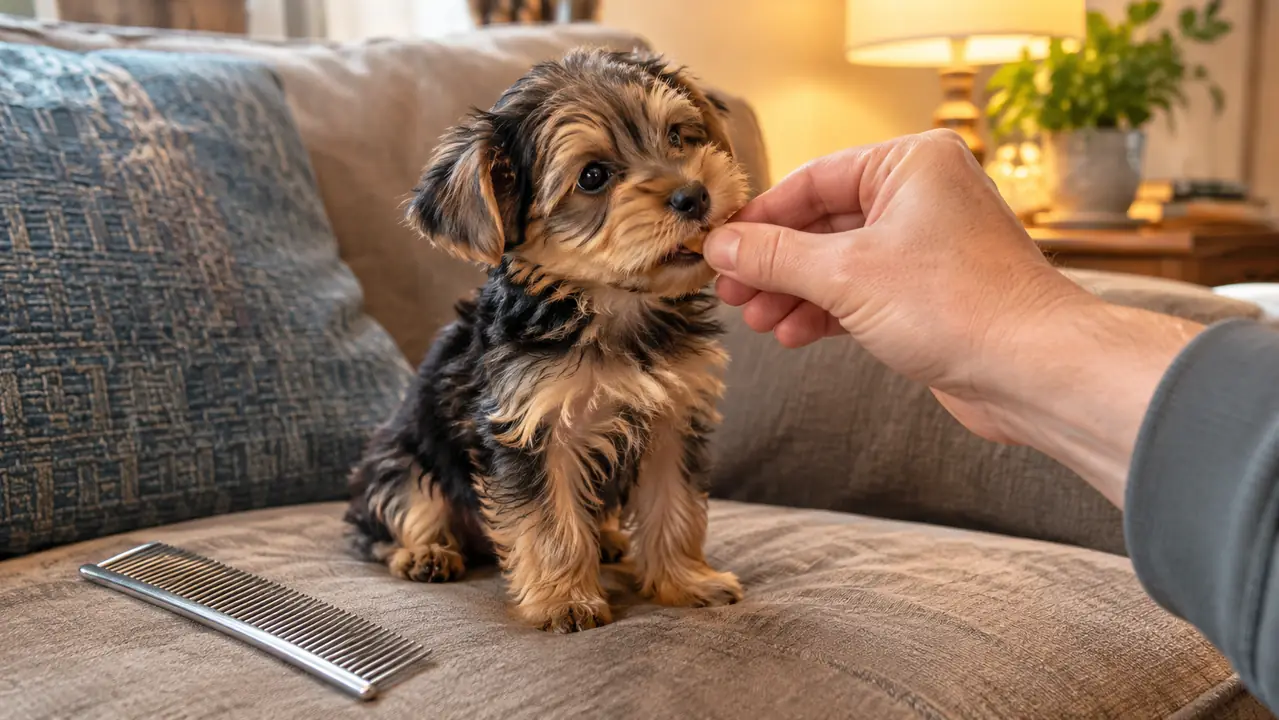
Step 4: Break the Hard Spots Into Tiny Pieces
Clover hates having her paws touched. Not mildly. She pulls her leg back like I am stealing it. So paws get their own rules: one touch, one treat, done. Some nights I only do one paw. On a good night I do two, one light pass each, and that is the whole paw session. It has taken months to get to the point where I can hold a paw for three seconds without a struggle, and I am not pushing past that. Paw handling matters for nail trims and for the vet, and I would rather get there slowly than lose it.
Behind the ears and in the armpits is where the mats actually form, and the groomer told me on August 22 to keep after both. Those spots get the last two minutes, after she is warm and half asleep. I part the coat with my fingers, brush outward from the skin in small sections, and stop the moment she stiffens. Stiffening is the signal. Ignore it once and you spend the next three nights rebuilding trust, which is a worse trade than a skipped armpit.
One honest limit: this brush will not dissolve a mat that has already set tight against the skin. If I find one that does not come apart with a few light passes, I leave it for the groomer. Sawing at a knot with a slicker is how you teach a dog to hate the couch, and it does not do the coat any favors either. Some jobs are worth paying someone to do.
Step 5: Stop While She Still Likes It
Five minutes, most evenings. Some nights it is three. The session ends while Clover is still comfortable, not when she has had enough, because the memory she carries into tomorrow is the last thirty seconds. Stop while she is relaxed and she shows up again. Push through the last armpit just to finish the job and she does not. I work Monday to Thursday, so Thursday nights I am tired, and I have learned to do a short session rather than skip it. Short and boring beats a big production on Saturday.
After the brush comes the comb. I own one cheap steel comb from a pet store and its only job is the check. I run it through the coat in the same order and see where it catches. If it catches, I missed a spot, and the brush comes back out for ten seconds. This is the step that keeps a grooming appointment from turning into a dematting appointment, and it takes about half a minute if you do it every night.
Then I pull the loose hair out of the pins with my fingers, which takes about four seconds, and the brush goes back in the basket by the couch. A brush that lives in a drawer does not get used. A brush that lives where the dog already lies down gets used every night, and the routine survives the weeks when you are tired.
Five minutes most evenings, one groom in August, and a coat that has not matted behind the ears since June. That is the whole system.
What Else Helps
The brush is one part of it. The other part is a groomer every eight to twelve weeks, and I have exactly one appointment to go on, August 22. What she said was simple: keep brushing behind the ears and in the armpits, because that is where a doodle coat fails first. She also said the puppy coat can change again, so what works at seven months may not be what works at a year. I am not planning any changes until something stops working.
Other small things that helped. Brushing after a walk instead of before, because Clover is tired and the session is calmer. A frozen stuffed KONG on the nights she was teething and would not settle, so brushing was not competing with a sore mouth. Keeping the whole thing boring: same couch, same order, no excited voice, no party at the end. And a treat right after the comb, every single time, so the last thing that happens is the good thing.
One thing I would not do is brush a coat that is already tangled and dry and expect the brush to sort it out on its own. And if the skin under the coat looks red, or she is scratching at one spot, that is a question for your vet, not a brushing problem. No brush on the shelf will fix a skin issue, and the honest answer is to ask someone who can actually look at it.
Five Minutes a Night, and a Coat You Can Stay Ahead Of
One size, small enough for the puppy and for the small dog she will grow into. The pins flex, the tips are coated, and the routine is the same every night.
Amazon Check Today's Price on Amazon →